Triassic Period (252-201 mya)
The Triassic began the Mesozoic Era in a barren, recovering world. Pangaea remained intact, and its vast interior was hot and arid. Life rebuilt slowly after the Permian extinction, but new forms soon flourished.
Reptiles diversified rapidly. On land, archosaurs, the group including crocodilians and dinosaurs, rose to dominance. The first true dinosaurs appeared around 230 million years ago, small, agile and often bipedal, such as Eoraptor. In the oceans, ichthyosaurs, which resembled dolphins, and long-necked plesiosaur relatives took over. Pterosaurs became the first vertebrates to master powered flight.
Our own ancestors were present too. The first mammals appeared in the late Triassic: tiny, shrew-like, probably nocturnal creatures that lived in the shadow of larger reptiles. Early turtles and frogs also emerged. Plant life was dominated by ferns, cycads and conifers.
Near the end of the period, Pangaea began to rift apart. Large volcanic eruptions in what is now the Atlantic region triggered another mass extinction about 201 million years ago, eliminating many competitors of the dinosaurs. This opened the door for dinosaurs to dominate the Jurassic.
A Slow Recovery
The early Triassic was a desolate time. In the aftermath of the Great Dying, ecosystems were stripped to a skeleton. Reefs vanished for about ten million years, forests were gone, and the climate was extremely hot. In the tropics, temperatures at times may have been too high for many animals to survive on land or at the sea surface.
Recovery was slow and uneven, taking perhaps five to ten million years before diverse ecosystems returned. The first survivors were opportunists. On land, the pig-sized Lystrosaurus spread across Pangaea, so that its fossils are found in South Africa, India, Antarctica and China, a fact that helped early scientists prove that the continents were once joined. In the oceans, small, fast-reproducing mollusks dominated.
The middle Triassic saw a more complete recovery. New kinds of coral built reefs, and scleractinian corals, the group that builds today’s reefs, first appeared. Land plants rebuilt as well, with forests of conifers, ginkgoes, cycads and seed ferns, and the horsetails spread in wetter areas.
Pangaea at Its Peak
Pangaea was at its largest in the Triassic, spanning nearly all of Earth’s land. The interior was a vast desert, with extreme heat in summer and cold in winter. The coasts had strong monsoon climates. There was probably little or no ice anywhere on Earth.
Evidence for the dry climate is found in the red rocks of the American Southwest, such as the Petrified Forest in Arizona, where Triassic logs have turned to colorful stone. Rift valleys began to open along the length of Pangaea late in the period, particularly between eastern North America and Africa. Lakes formed in the rifts, and their sediments preserve many fossils, including the dinosaur footprints of the Connecticut River Valley, which span the Triassic-Jurassic boundary and are mostly Early Jurassic.
The Archosaurs Take Over
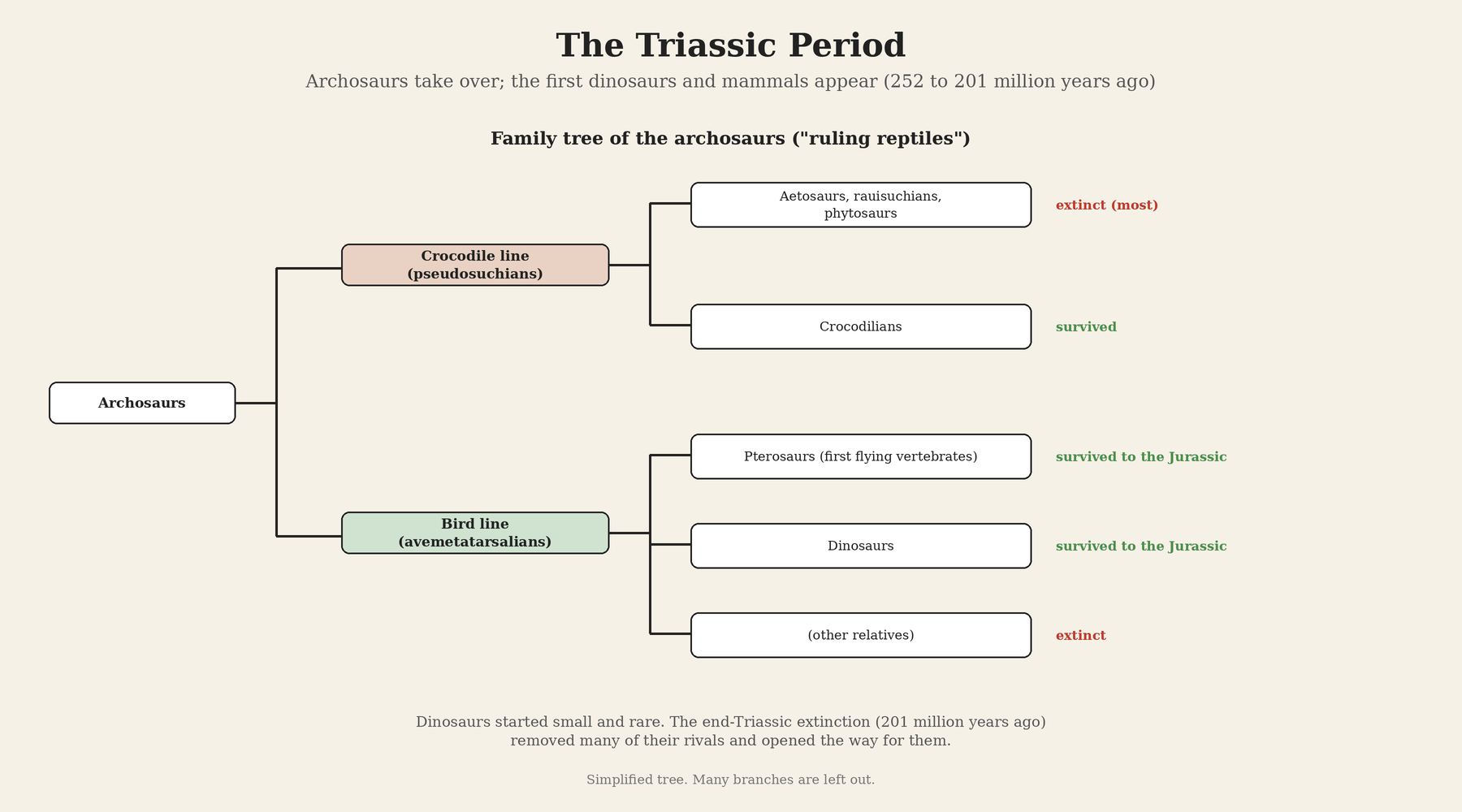
The biggest story of the Triassic is the rise of the archosaurs, the “ruling reptiles.” This group includes crocodilians, pterosaurs, dinosaurs and birds. In the Triassic, they split into two main lines: the pseudosuchians, which led to crocodiles, and the avemetatarsalians, which led to dinosaurs and pterosaurs.
For most of the period, it was the pseudosuchians that dominated. Large predators like Postosuchus and the armored, plant-eating aetosaurs ruled the land, while crocodile-like phytosaurs lurked in rivers. Rauisuchians were top predators, some five meters long. Dinosaurs were relatively minor players, living in the shadow of these crocodile relatives.
Synapsids were still around. Dicynodonts like Lisowicia, a Late Triassic form the size of an elephant, were big herbivores. But gradually, the archosaurs gained the upper hand, helped perhaps by more efficient breathing and upright posture.
The First Dinosaurs
The oldest dinosaur fossils, from Argentina and Brazil, are about 230 to 240 million years old. Early forms such as Eoraptor, Herrerasaurus and Staurikosaurus were small to medium-sized, bipedal and fast-moving, probably omnivores or predators. At first they were few, and in many ecosystems they made up only a small fraction of the animals.
They had features that may have given them an edge: legs held directly below the body, efficient respiration and probably a fast metabolism. By the Late Triassic, plant-eating relatives of the long-necked sauropods, called sauropodomorphs, such as Plateosaurus of Europe, had appeared and were growing larger. Early theropods such as Coelophysis, a slender predator about three meters long, hunted in packs, or at least congregated in large numbers, at a site in New Mexico.
The dinosaurs’ great dominance was yet to come. It would depend on another extinction, at the end of the period.
Reptiles of the Sea and Sky
The Triassic seas were occupied by marine reptiles that had returned to the ocean. Ichthyosaurs, with dolphin-like bodies, evolved quickly into streamlined hunters; some reached 15 meters or more, like the giant Shonisaurus. Nothosaurs, with long necks and paddle-like limbs, hunted fish near coasts, and their relatives, the plesiosaurs, would flourish in the Jurassic. Placodonts, armored and shell-crushing, fed on mollusks. Sharks, bony fishes and ammonites were abundant too.
In the air, pterosaurs took flight around 220 million years ago. Their wings were made of skin stretched over a hugely elongated fourth finger. Early pterosaurs such as Eudimorphodon were small, with long tails and sharp teeth. They were the first vertebrates to fly under their own power, and they ruled the skies for 150 million years.
The Dawn of Mammals
In the shadow of the archosaurs, a lineage of small cynodonts was gradually acquiring mammalian traits. By about 225 million years ago, creatures such as Adelobasileus and Morganucodon appear in the fossil record. They were tiny, often the size of a shrew, with sharper senses and probably warm blood and fur.
Most were nocturnal insect eaters, which let them avoid competition with the reptiles by day. The jaw bones of cynodonts gradually shrank and moved into the ear, eventually forming the three-ear-bone arrangement unique to mammals. This is one of the best-documented examples of evolutionary change in the fossil record.
For the next 135 million years, mammals would stay small, but they persisted, and from this humble start the whole lineage emerged.
The End-Triassic Extinction
About 201 million years ago, Pangaea began to break apart, and as it did, huge volcanic eruptions poured out across what is now the Atlantic region. This region, called the Central Atlantic Magmatic Province, produced vast basalt flows that now lie in eastern North America, northwest Africa, and South America.
As with the Permian crisis, the eruptions released large amounts of carbon dioxide, causing rapid warming and ocean acidification. About 76 percent of species are estimated to have been lost, including most large pseudosuchians, many marine reptiles, ammonites and conodonts, the latter ending a 300-million-year run.
Dinosaurs made it through. With their main competitors gone, they inherited a world of open opportunity. Within a few million years they spread to every continent, growing to ever greater sizes. The Triassic thus served as a prologue to the Mesozoic’s most famous era.