Jurassic Period (201-145 mya)
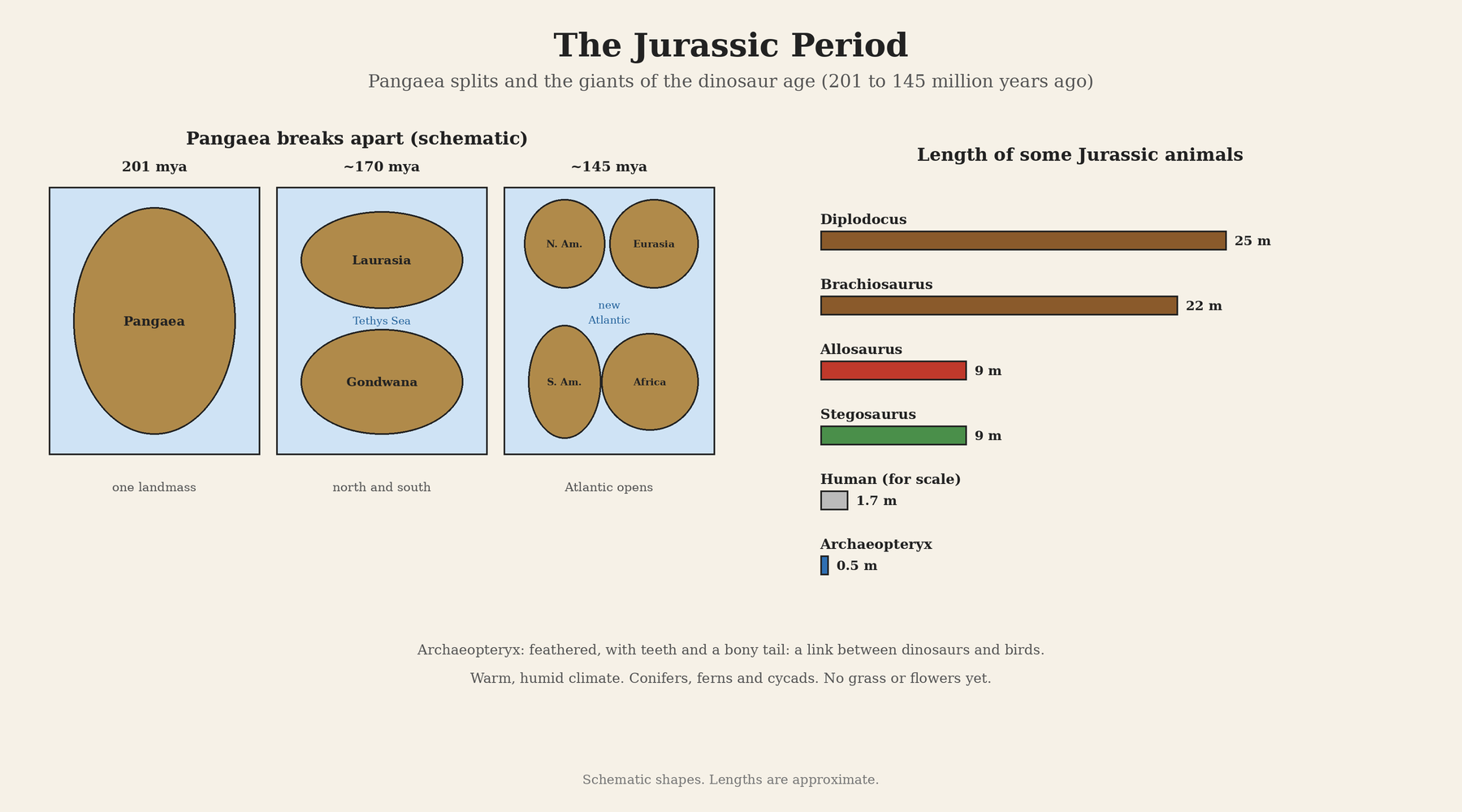
The Jurassic is the most famous period of the dinosaur age. Pangaea continued to split, forming the early Atlantic Ocean and separating a northern landmass, Laurasia, from a southern one, Gondwana. The climate was warm and humid, with lush forests of conifers, ferns and cycads even near the poles.
Dinosaurs reached giant sizes. Long-necked sauropods such as Brachiosaurus and Diplodocus browsed the treetops, while predators like Allosaurus hunted them. Armored Stegosaurus roamed too. The Jurassic also marks the first appearance of birds: Archaeopteryx, a feathered, toothed creature that shows the evolutionary link between small theropod dinosaurs and modern birds.
The seas were home to ichthyosaurs, plesiosaurs, huge marine crocodiles and swirling ammonites. In the air, pterosaurs soared. Our mammalian ancestors remained small, but they diversified in size and habits, with some swimming, gliding or digging.
Rich fossil beds of this age, such as the Morrison Formation in the western United States and the limestones of Solnhofen in Germany, have given us some of the most detailed pictures of any prehistoric ecosystem. The period is named after the Jura Mountains of Europe.
A Green and Splitting World
At the start of the Jurassic, Pangaea was still joined, but it was quickly breaking up. A rift opened in the middle, separating the northern landmass, Laurasia, from the southern one, Gondwana, along the Tethys Sea. A new ocean, the central Atlantic, widened between North America and Africa. Later in the period, Gondwana itself began to fragment, as the Indian Ocean opened between Africa and Antarctica.
The climate was warm and generally humid, with no polar ice caps. Without the extreme dry interior of the Triassic, the desert belts shrank and lush vegetation expanded. The seas rose and flooded the continental margins, creating shallow seaways, including one across much of Europe.
Forests were made of conifers, ginkgoes, cycads, tree ferns and horsetails. There were no grasses and no flowering plants yet. The forest floor was covered with ferns, so a Jurassic landscape would have looked green but different from anything alive today.
The Giants
Jurassic dinosaurs are famous for their size. The sauropods, long-necked plant-eaters, reached colossal proportions. Diplodocus was about 25 meters long, with a whip-like tail. Brachiosaurus, with front legs longer than its hind legs, held its head up to 12 meters high. Camarasaurus was a common, sturdy form. Larger yet were relatives such as Supersaurus and Argentinosaurus (the latter from the Cretaceous), which may have exceeded 70 tonnes.
How did such creatures function? Their bones were hollow in places, with air sacs similar to those of birds, which lightened the skeleton and helped breathing. They had small heads and swallowed plant matter without chewing. They probably grew fast, laid many small eggs, and moved in herds. The massive size made adults almost immune to predators.
The best-known fossil site is the Morrison Formation of the western United States, spanning Colorado, Utah, Wyoming and neighboring states, which has yielded Allosaurus, Stegosaurus, Apatosaurus and many others. Similar faunas have been found in Tanzania at Tendaguru, and in Portugal and China.
Predators and Armored Plant-Eaters
The top predators of the Late Jurassic were large theropods. Allosaurus, up to 9 meters long, was the dominant carnivore of the Morrison, with a large head, serrated teeth, and strong arms with three clawed fingers. Ceratosaurus, with a horn on its snout, and the huge Torvosaurus shared the landscape. Smaller, fast predators like Compsognathus hunted lizards and insects.
Plant-eaters also included armored and plated forms. Stegosaurus, with its row of diamond-shaped plates on the back and four spikes on its tail, is one of the most recognizable. The purpose of its plates is debated; display, thermoregulation and defense are all possibilities. Early ankylosaurs also appeared, and ornithopods such as Camptosaurus and Dryosaurus grazed on low vegetation.
The First Birds
Perhaps the most important Jurassic fossil of all is Archaeopteryx, found in the fine-grained Solnhofen limestone of Bavaria, Germany, in 1861. Only two years after Darwin published On the Origin of Species, it seemed to be the perfect transitional fossil. It had feathers and wings, like a bird, but also teeth, clawed fingers and a long bony tail, like a dinosaur.
Since then, discoveries, especially in northeastern China, have revealed many feathered dinosaurs, some of them older than Archaeopteryx. Species like Anchiornis had feathers on both arms and legs, and some had four wings. The evidence strongly supports the view that birds are living dinosaurs, descended from small theropods. Feathers evolved before flight, probably for insulation and display.
Masters of the Sea and Air
The Jurassic seas were full of marine reptiles. Ichthyosaurs such as Ophthalmosaurus had huge eyes and hunted at depth. Plesiosaurs evolved two main forms: long-necked types with small heads, and short-necked pliosaurs with massive jaws, such as Liopleurodon, a big predator which was a few meters shorter than early estimates suggested. Marine crocodiles also thrived. Ammonites and belemnites (squid relatives with internal shells) were extremely abundant.
Pterosaurs diversified. The long-tailed forms of the early period gave way to short-tailed pterodactyloids such as Pterodactylus, which flew over lagoons catching fish. They are known in exquisite detail from Solnhofen, where fine mud preserved wing membranes.
Small Creatures Beneath the Giants
Mammals remained small, but they were more varied than once believed. Discoveries from China and elsewhere show that Jurassic mammals took a surprising range of lifestyles. Castorocauda was a beaver-like swimmer with a flat tail and webbed feet. Volaticotherium was a glider, and Fruitafossor dug for insects, like an anteater. In the following Cretaceous, a badger-sized mammal called Repenomamus is known to have eaten young dinosaurs.
Insects thrived too, including early flies, beetles, wasps and the ancestors of butterflies and moths. Amber from this time is rare, so most insect fossils come from fine lake deposits, such as those at Daohugou in China.
A Warm, Productive Planet
The Jurassic was a stable and productive period. Oceans were teeming, and organic-rich shales formed at the bottom, becoming source rocks for much of the world’s oil and gas, including that of the North Sea and the Middle East.
At the end of the period, there was no mass extinction of the largest sort, only a gentle change of fauna. Some groups such as stegosaurs declined, and new forms arrived. The Jurassic–Cretaceous boundary, about 145 million years ago, is one of the less well-defined boundaries in the geological timescale, and it is still debated where precisely to put it. It was a long, warm afternoon for the age of reptiles, and the best of it lay ahead.