Permian Period (299-252 mya)
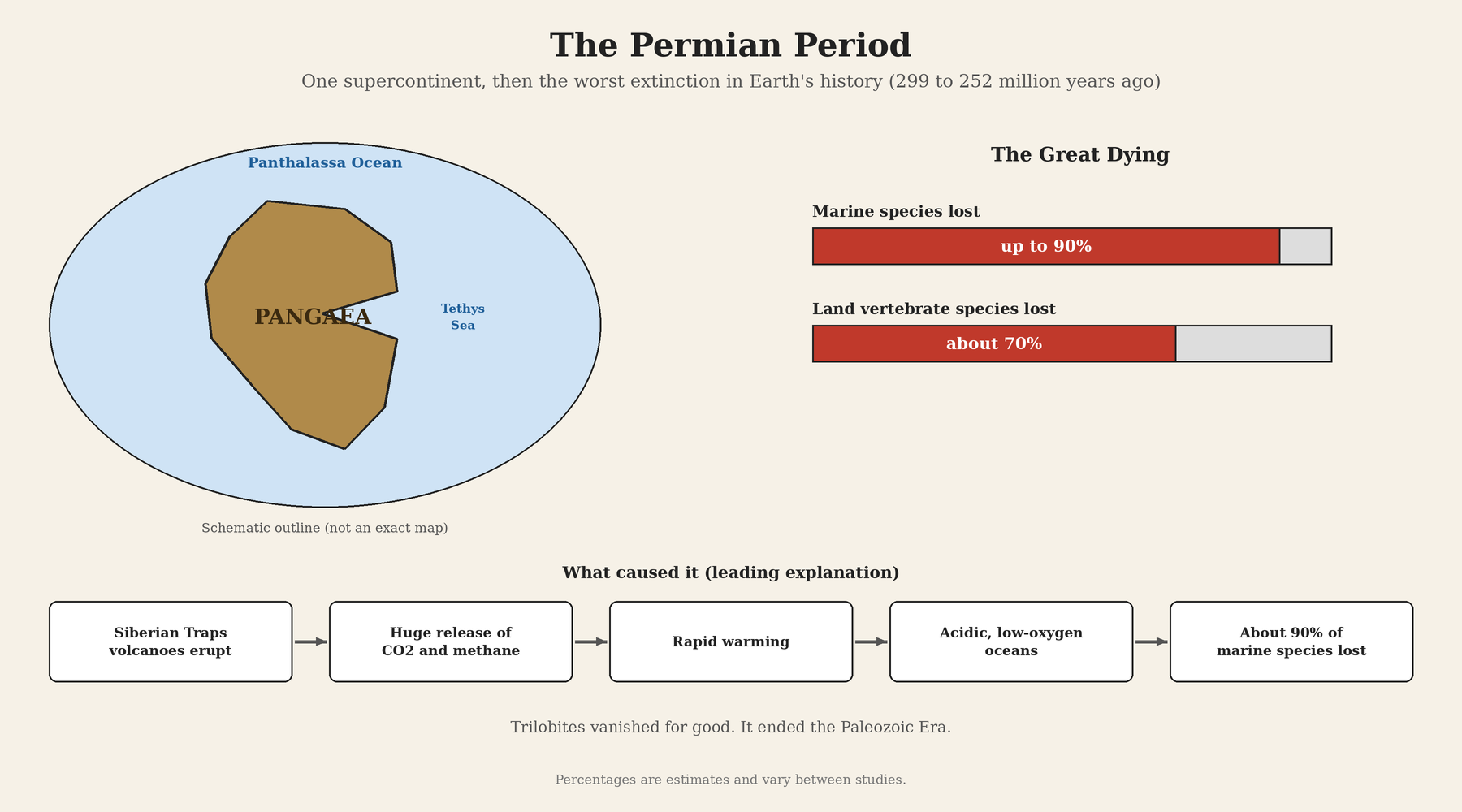
The Permian was dominated by Pangaea, a single enormous supercontinent surrounded by one vast ocean. Its interior grew increasingly hot and dry, producing deserts, while ice lingered near the southern pole in the early part of the period.
On land, the reptile-like synapsids, ancestors of mammals, thrived. Sail-backed Dimetrodon, which is often mistaken for a dinosaur, was a top predator, and later therapsids, more mammal-like, became diverse. Conifers and seed plants replaced much of the swamp vegetation. The seas teemed with reefs, brachiopods, sharks and ammonoids.
Then came the worst disaster in Earth’s history. About 252 million years ago, the “Great Dying” wiped out roughly 90 percent of marine species and about 70 percent of land vertebrate species. The leading explanation is massive volcanic eruptions in Siberia, which released enormous amounts of carbon dioxide and methane. These caused rapid global warming, ocean acidification and oxygen-poor seas.
Trilobites vanished for good. Recovery took millions of years, but the extinction cleared the stage for new groups, including the reptiles that would give rise to the dinosaurs. It marks the end of the Paleozoic Era.
The World of Pangaea
For the first time in this story, almost all of Earth’s land was joined. Pangaea, meaning “all earth,” stretched from pole to pole, with a single ocean, Panthalassa, covering the rest of the globe. A great bay on its eastern side, the Tethys Sea, cut into the supercontinent.
With so much land far from the sea, the interior became extremely continental: hot, dry and seasonal. Vast deserts developed, and red beds of windblown sand and dried mud formed across the supercontinent, as in the American Southwest. Monsoon systems of extreme strength brought seasonal rains to the coasts.
The early Permian was cold. The Late Paleozoic Ice Age that began in the Carboniferous continued, and glaciers covered much of southern Gondwana. But as the period progressed, the ice melted, and the world warmed steadily. By the end, the climate was hot, with no polar ice.
Early Permian Life on Land
The early Permian is best known for the fossil beds of Texas and Oklahoma, preserved in red sandstones and shales. They record a world dominated by amphibians and early synapsids, the group that includes mammals and their relatives. Sometimes called “mammal-like reptiles,” synapsids are not reptiles at all, but a separate branch of amniotes.
The sail-backed Dimetrodon, up to 3.5 meters long, was the top predator. Its sail, supported by long spines from the vertebrae, may have regulated its body temperature or been used for display. Dimetrodon is more closely related to us than to dinosaurs, which had not yet evolved. Its herbivorous contemporaries included Edaphosaurus, which also had a sail, and the bulky Diadectes.
Amphibians such as the broad-headed Eryops continued to flourish near water. Meanwhile, conifers, cycads and other seed plants, which tolerated dry conditions better than spore-bearing plants, spread across the continents.
Therapsids and the Rise of the Mammal Line
In the later Permian, a more advanced group of synapsids, the therapsids, took over. Their legs were held more directly under the body than in sprawling reptiles, and their teeth were differentiated into incisors, canines and cheek teeth, much like those of mammals. Some may have had hair and a higher metabolism, though this is debated.
The best fossil records come from the Karoo Basin of South Africa and from Russia. There lived the fierce gorgonopsians, saber-toothed predators up to three meters long, and the dicynodonts, beaked herbivores that were the most common plant eaters, some as large as cattle. Lystrosaurus, a stocky, pig-sized dicynodont, would later become famous for surviving the extinction.
Other therapsids, the cynodonts, were smaller and more mammal-like, and from them mammals would eventually arise in the Triassic. The ancestors of every mammal alive today, including humans, were therefore present in the Permian, scurrying beneath the larger beasts.
Permian Seas
The Permian seas were rich, and reef ecosystems recovered. Brachiopods, bryozoans, sponges, crinoids and corals built extensive reefs, including the Capitan Reef of Texas and New Mexico, now exposed in Guadalupe Mountains National Park. Ammonoids, coiled-shelled relatives of squid and octopus, were highly diverse. Trilobites, once the stars of the Paleozoic, were reduced to a handful of species.
Fusulinids, single-celled organisms with shells the size of rice grains, flourished in huge numbers and are used for dating. Sharks, including odd forms like Helicoprion, with its spiral tooth whorl, hunted alongside bony fishes. The ocean was complex and productive, and nothing in its fossils hinted at what was to come.
Siberian Fire
Around 252 million years ago, a gigantic series of volcanic eruptions began in what is now Siberia. They created the Siberian Traps, a huge region of lava flows covering millions of square kilometers and in places thousands of meters thick. Eruptions continued for perhaps a million years.
The lava itself may not have been the killer. The key was what came with it. The magma burned through deposits of coal, oil and salt, and released enormous quantities of carbon dioxide, methane, sulfur dioxide and chlorine-containing gases. Some researchers think the eruptions also destroyed the ozone layer.
The consequences were global. Carbon dioxide caused severe warming, perhaps 8 to 10 degrees Celsius or more. The oceans absorbed some of the gas and became more acidic. Warm water holds less oxygen, so large areas of the ocean became oxygen-poor, with poisonous hydrogen sulfide in places. On land, acid rain, wildfires and heat devastated forests.
The Great Dying
The end-Permian extinction was the worst in Earth’s history. By most estimates, about 81 to 90 percent of marine species and around 70 percent of land vertebrate species disappeared. Insects, which had survived every previous crisis, suffered their only major extinction. Entire groups were lost for good: trilobites, rugose and tabulate corals, blastoids and many others.
The extinction may have unfolded over tens of thousands of years or less, which is geologically instantaneous. Forests died, and a “fungal spike” in the fossil record suggests massive decay. Coal deposits are missing from the early Triassic, a “coal gap” that shows how thoroughly plant life was disrupted.
Survivors were often small and tough. On land, Lystrosaurus became overwhelmingly abundant for a time, and in the sea, a few mollusks and brachiopods hung on. This pattern of “disaster taxa” is typical of the aftermath of major extinctions.
Why It Matters
The Great Dying is a case study for modern times. It shows that a sudden release of carbon into the atmosphere can warm the planet, acidify the ocean and devastate life. Though the rate then was probably slower than humans are emitting carbon now, the parallel is a subject of serious scientific attention.
It also changed the course of evolution. The old order of the Paleozoic, with its trilobites, rugose corals and many synapsids, was swept away. In the ruins, new groups would flourish, among them the archosaurs and the ancestors of the dinosaurs. The end of the Permian marks the end of the Paleozoic Era, “ancient life,” and the opening of the Mesozoic, “middle life.”