Silurian Period (443-419 mya)
The Silurian was a time of recovery and expansion. As the ice sheets of the late Ordovician melted, sea levels rose again and the climate warmed, creating widespread shallow seas and extensive coral reefs.
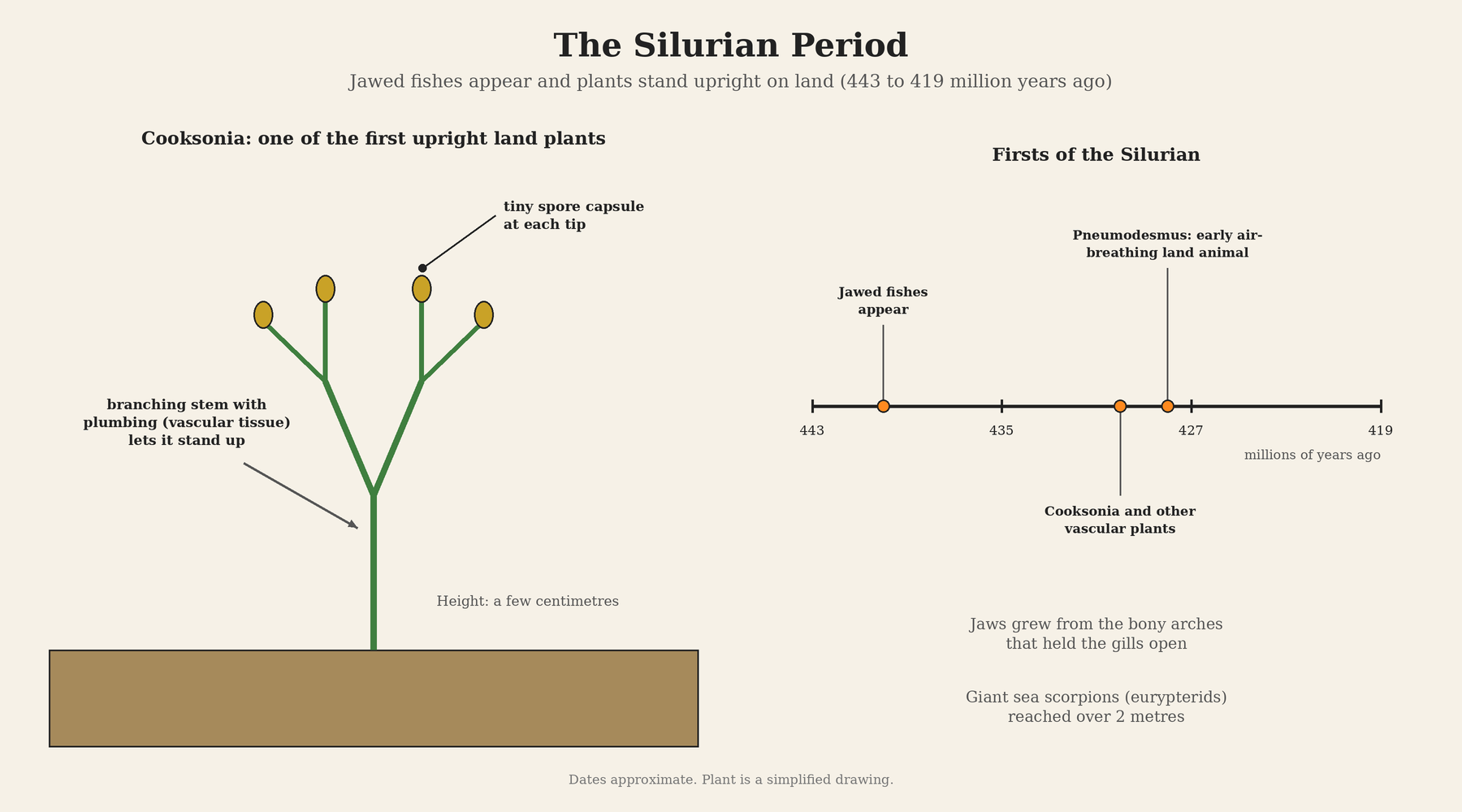
Marine life rebounded. Sea scorpions, called eurypterids, became formidable predators, some growing over two meters long. Jawed fishes appeared and began to diversify, a pivotal step, since jaws would eventually lead to the success of nearly all vertebrates, including us. Armored jawless fishes remained common.
The most important events, however, happened on land. Plants developed vascular tissue, tubes that carry water and nutrients, allowing them to stand upright. Cooksonia, a tiny branching plant only a few centimeters tall, is among the earliest known. Alongside came the first land animals: small arthropods such as early millipedes and scorpion-like creatures that grazed or hunted among the primitive vegetation.
Fungi were likely establishing partnerships with these early plants.
The Silurian is named after the Silures, an ancient Celtic tribe of Wales, where its rocks were first studied. It ended quietly, flowing into the Devonian without a major extinction.
Warm Seas After the Ice
The Silurian opened with the world still recovering from the ice age that ended the Ordovician. As the glaciers melted, sea levels rose, flooding the continental shelves once more. The climate settled into a warm, relatively stable greenhouse state, with little ice at the poles. Carbon dioxide levels remained much higher than today’s, and the oceans were warm.
The continents were slowly converging. Laurentia (North America) and Baltica (northern Europe) collided during this period, closing the Iapetus Ocean and forming a larger landmass called Laurussia. The collision raised the Caledonian mountains, whose eroded remnants today form the highlands of Scotland, Scandinavia, Greenland and the northern Appalachians. To the south, the great continent of Gondwana remained, and between them lay the Rheic Ocean.
The shallow seas that covered the continental interiors were ideal places for life, and coral reefs spread widely. In places like the Great Lakes region of North America, Silurian reefs now form limestone and dolomite, quarried for building stone and sometimes harboring oil and gas.
Reefs and Seafloors
Silurian reefs were built by tabulate and rugose corals, stromatoporoids (sponge-like organisms that formed massive mounds), and calcareous algae. They were bigger and more elaborate than any before, forming barrier reefs and atolls. Around them lived a variety of creatures. Crinoids, or sea lilies, grew in dense meadows; brachiopods carpeted the seabed; and trilobites, though less dominant than before, were still diverse.
Gently waving beds of crinoids sometimes created thick limestones made almost entirely of their broken stems. Graptolites floated in open water and evolved rapidly, so their fossils are among the best tools for dating Silurian rocks around the world. Their changing shapes record time like the ticks of a clock.
Cephalopods remained abundant, including long-shelled nautiloids and newly evolving coiled forms. Gastropods and bivalves occupied many niches, and the seabed was a busy place.
Sea Scorpions and Other Predators
The most fearsome Silurian predators were not fishes but eurypterids, or sea scorpions. They were arthropods with a segmented body, a tail, and pairs of paddle-like swimming legs. Despite the name, they were not true scorpions. Many were small, but some became huge. Pterygotus, from the late Silurian and Devonian, reached about 2 meters, and Jaekelopterus, from the Devonian, may have been 2.5 meters long, with claws for grasping prey.
Eurypterids hunted in lagoons, estuaries and shallow seas, and some may have ventured into brackish and fresh water. They hunted fishes and other arthropods, and for a time, they were among the top predators of the seas, rivaling the largest fishes.
Other invertebrates, such as the giant nautiloids that had dominated the Ordovician, declined somewhat in dominance as fishes became more capable. Their time as top predators was ending.
The Rise of Jawed Fishes
The vertebrate story took a decisive step in the Silurian. Earlier fishes, such as the Ordovician Arandaspis, were jawless, filter-feeding or scavenging creatures encased in bony armor. They had mouths that were simple openings, and could not bite.
Jaws evolved from the supporting arches of the gills. Several of the bones that once held the gills open were modified into a hinged jaw, an elegant example of evolution repurposing existing parts. The earliest jawed fishes appear in the Silurian, around 440 million years ago. They include the placoderms (armored fishes), acanthodians (“spiny sharks”), and by the late Silurian, the first bony fishes, such as Guiyu from China, about 425 million years old.
Jaws let vertebrates take on new kinds of food, from hard-shelled prey to other fishes, and set off a new arms race. Almost all vertebrates today, from sharks to humans, are jawed vertebrates, descended from this innovation. Jawless fishes continued, but they would decline, leaving only lampreys and hagfish.
Plants Take Hold
The real revolution of the Silurian happened on land. Plants had existed as small, moss-like forms since the Ordovician, but in the Silurian, they developed vascular tissue, a plumbing system that carries water and nutrients and also gives stiffness. This allowed them to grow upright and tall.
The oldest known vascular plant fossils are Cooksonia, appearing around 430 million years ago. They were minute, with simple branching stems that ended in spore-bearing tips, no leaves, and no true roots. They grew in damp lowlands and swamps, forming low green carpets. Later in the period, other forms such as Baragwanathia from Australia, which had small leaf-like structures, appeared.
Although these plants were small, they started a chain of consequences. They stabilized sediments, changed river flows, and began creating soil. They fed new kinds of animals. And as the plants spread, they began to pull carbon dioxide out of the air, a process that would continue and intensify in the next period.
The First Land Animals
Where plants go, animals follow. The earliest evidence of land animals comes from the Silurian, where fossils of small arthropods are found in rocks that were deposited on land. The creatures included early millipedes, such as Pneumodesmus, about 428 million years old from Scotland, which is the oldest known air-breathing land animal. It had tiny openings along its body for taking in air, similar to those of modern millipedes.
Other early land dwellers included centipede-like arthropods, mites, scorpion-like arachnids and springtails. They probably fed on decaying plant matter and fungi, or hunted each other. Because they were small, and early land habitats were damp and low, they left only a modest fossil record.
Moving onto land was difficult. Animals needed ways to avoid drying out, to support their weight without water, and to breathe air. Arthropods, with their waterproof outer skeletons, had a head start.
A Calm Ending
In contrast with the periods that came before and after, the Silurian ended without a major mass extinction. There were several smaller events, such as the Ireviken, Mulde and Lau events, in which some marine groups declined and the carbon cycle shifted. They are often linked to climate fluctuations, and they affected groups such as conodonts, graptolites and trilobites.
The Silurian-Devonian boundary around 419 million years ago is chosen by a change in graptolite species, in a rock section in the Czech Republic. Life had by then proved that it could recover from catastrophe, and the stage was set for the Devonian, a period of both dazzling diversity and a deepening influence of life on the planet itself.