Devonian Period (419-359 mya)
The Devonian is often called the Age of Fishes. Armored placoderms, some like Dunkleosteus, about three to four meters long, with bone-shearing jaws, ruled the seas. Sharks, ray-finned fishes and lobe-finned fishes all flourished.
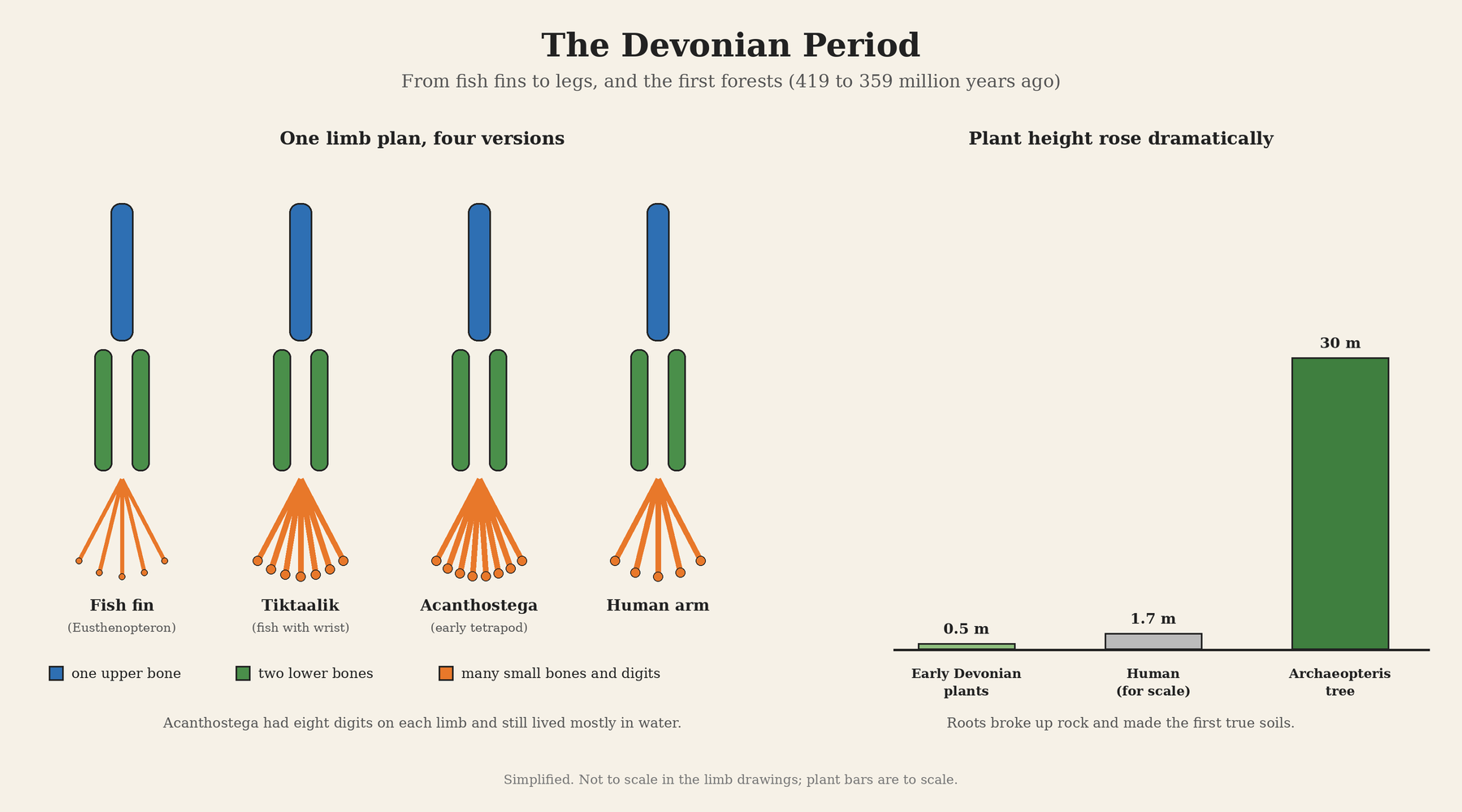
It was also a turning point for the land. The first forests appeared, with trees such as Archaeopteris reaching ten meters or more. Deep roots broke up rock, formed the first true soils, and pulled carbon dioxide from the air, cooling the climate. Seed-bearing plants evolved late in the period.
Among the lobe-finned fishes, some developed sturdy fins and primitive lungs. Creatures like Tiktaalik hint at the transition from fin to limb, and by the end of the period the first four-limbed vertebrates, the tetrapods, were crawling in shallow water and onto land. Insects also appeared.
The period’s closing chapters were turbulent. A series of pulses, known as the Late Devonian extinction, devastated marine life, especially reef ecosystems and many armored fishes. Possible causes include falling oxygen in the oceans, climate change and the ecological upheaval caused by the spread of forests.
Even so, life on land had gained a lasting foothold.
A Supercontinent in the Making
The Devonian world was dominated by two great landmasses and one vast ocean. In the north, Laurussia (also called Euramerica), formed by the earlier collision of North America and Europe, straddled the equator. The red sandstones of this time, known as the Old Red Sandstone, cover large parts of Britain and are famous for their fossil fishes. In the south, Gondwana remained, still huge, and between them lay the Rheic Ocean, slowly narrowing.
A single great ocean, Panthalassa, covered most of the globe. The climate was warm, with high sea levels and no major polar ice for most of the period. Carbon dioxide began to decline, partly because of the spread of forests, but the Devonian was still warmer than today.
Warm shallow seas covered much of the continents, supporting the largest coral reefs in Earth’s history. The Great Barrier Reef of today would be dwarfed by the Devonian reef systems, which stretched across Europe, North America and Australia. Parts of them survive as limestone hills, including remarkable fossil reefs in Western Australia.
The Age of Fishes
The Devonian is justly called the Age of Fishes. Nearly every major group of fishes was present, and they dominated waters from the sea to rivers and lakes.
The placoderms, or armored fishes, reached their peak. Their heads and shoulders were covered with bony plates, and some had hinged joints in their armor. Among the biggest was Dunkleosteus, which grew to roughly three to four meters (older estimates of six meters or more have been revised downward) and had self-sharpening bony blades in place of teeth. With a bite force that rivals large modern predators, it was likely the apex predator of its time.
Sharks and their relatives were becoming more common. Cladoselache, an early shark, was streamlined and fast. Ray-finned fishes, the group that would eventually include most living fishes, such as salmon, tuna and goldfish, were diversifying, though they were still small. And alongside them were the lobe-finned fishes, with fleshy, muscular fins that held the key to the next step in vertebrate evolution.
Fins to Limbs
Among the lobe-finned fishes were forms that lived in shallow, oxygen-poor waters, swamps and streams, where having lungs and strong fins helped. Some of these fishes developed fins with an internal skeleton of bones that corresponds to the upper arm, forearm and wrist of land animals.
A famous transitional fossil is Tiktaalik, found in Arctic Canada in 2004 and dated to about 375 million years ago. It had a flat head with eyes on top, a neck that could move independently of the shoulders, and fins strong enough to prop the body up in shallow water. It is a fish with some of the features of a tetrapod, or four-limbed animal.
By the late Devonian, around 365 million years ago, true tetrapods appeared. Ichthyostega and Acanthostega, from Greenland, had legs with digits, though Acanthostega had eight fingers on each hand and still lived mostly in water. Rather than leaving the water to walk on land, they probably used their limbs to navigate shallow, plant-choked pools. Land living came later, but these animals are our ancestors.
The First Forests
On land, the Devonian was a time of remarkable greening. Plants developed leaves, roots, seeds and wood. At the start of the period, vegetation was only knee-high. By the end, there were forests.
Among the first trees was Archaeopteris, which appeared in the middle of the period and grew up to 30 meters tall. It had wood like a conifer and fern-like leaves, and it formed extensive woodlands around the world. A fossil forest at Gilboa, New York, dated to about 385 million years ago, preserves some of the oldest known tree stumps.
Giant fungi, such as Prototaxites, towered over the landscape. These stood up to eight meters tall, and for a long time scientists were unsure what they were. They were long thought to be enormous fungi, though a recent study argues they may belong to an extinct lineage of their own. Seed plants appeared by the end of the period, freeing plants from needing water to reproduce, and allowing them to spread to drier habitats.
How Trees Changed the Planet
The spread of forests transformed the Earth. Deep roots broke up bedrock and helped create the first thick, true soils, which allowed more plants and animals to thrive. Roots stabilized riverbanks, so rivers began to meander in single channels, rather than braiding over barren plains.
Trees also drew down carbon dioxide from the atmosphere through photosynthesis and the weathering of rocks. As carbon dioxide levels fell, the climate cooled, setting the stage for the ice ages of the late Paleozoic. At the same time, the extra nutrients washing into the sea fueled algal blooms, which depleted oxygen in the water when they decayed. Some scientists think this contributed to the extinction events that struck the oceans.
Land animals also diversified. Insects appeared, including wingless forms, and by the end of the Devonian, the first winged insects may have existed. Spiders, scorpions and mites inhabited the new forests.
Extinction Pulses
The Late Devonian was a time of crisis. Between about 372 and 359 million years ago, marine life suffered repeated blows, collectively called the Late Devonian extinction. Two main events, the Kellwasser event (around 372 million years ago) and the Hangenberg event (around 359 million years ago), caused large losses.
The extinctions hit the shallow tropical seas hardest. Reef builders were devastated, and the great coral-sponge reefs collapsed. It would be tens of millions of years before reef ecosystems fully recovered. Many placoderms vanished, including Dunkleosteus and its kin, as did many trilobites and brachiopods. About 75 percent of species were lost overall.
The causes are still debated. Candidates include oxygen-poor oceans caused by nutrient runoff from the new forests, climate cooling and glaciation, volcanism, and perhaps an impact. Probably more than one factor was involved.
Legacy
The Devonian ended with a changed world. Fishes remained diverse, but the armored giants had gone, and sharks and bony fishes would take over. Four-legged vertebrates had begun to leave the water. Forests carpeted the continents, and the groundwork for the coal swamps of the next period had been laid.
It was a time when life remade the planet, and the planet reshaped life in return. The great age of fishes had set the stage for the age of amphibians, our distant relatives, and for everything that crawled out of the water after them.