Ordovician Period (487-443 mya)
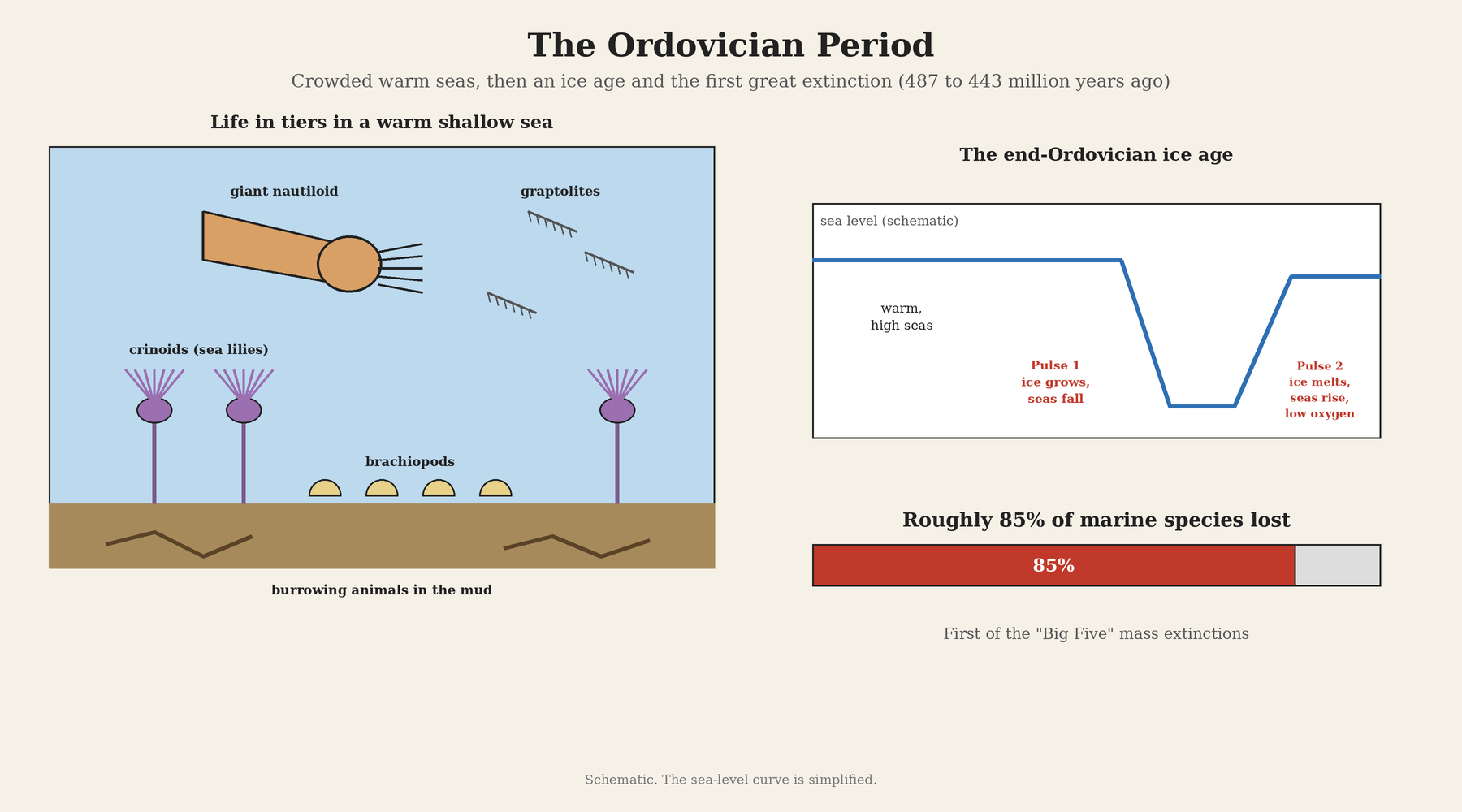
The Ordovician saw life diversify dramatically in the oceans, an episode called the Great Ordovician Biodiversification Event. Marine ecosystems became more complex, with filter feeders, reef builders and predators filling new niches.
Sea levels were among the highest in Earth’s history, and warm shallow seas covered much of the continents. Trilobites remained common, joined by brachiopods, bryozoans, corals and sea lilies. Giant cephalopods called nautiloids, some several meters long, were the top predators. Early jawless fishes swam in the seas.
On land, the first simple plants, similar to modern mosses and liverworts, may have begun to creep out of the water along damp shores.
The period ended in catastrophe. As Gondwana drifted over the South Pole, vast ice sheets formed, sea levels fell and the climate cooled sharply. The shallow-sea habitats where most life lived vanished or chilled.
The result was the first of the “Big Five” mass extinctions, wiping out roughly 85 percent of marine species. It was the second most severe extinction on record by percentage of genera lost, and it reshaped the oceans for the Silurian that followed.
A World of Shallow Seas
The Ordovician was a time of extreme sea levels. Because the continents were low and the climate was warm for much of the period, ocean water spilled over the land, drowning wide areas. Large parts of North America, including the interior, lay under a shallow tropical sea. Limestones from this time are rich in fossils and form the bedrock of places like Ohio, Kentucky and Tennessee.
Most land was still concentrated in the south, with Gondwana stretching from the equator over the South Pole. Other continents, such as Laurentia (North America), Baltica (northern Europe) and Siberia, were scattered in warm latitudes, separated by oceans such as the Iapetus and Rheic. These oceans would gradually close over the next hundred million years.
Carbon dioxide levels were many times higher than they are now, probably around fifteen times the present level, so the period was warm in spite of the Sun being a bit dimmer. Even so, by the end, ice would arrive.
The Great Ordovician Biodiversification Event
Where the Cambrian invented body plans, the Ordovician filled them in. Over about 25 million years, the number of marine families and genera more than tripled. This is known as the Great Ordovician Biodiversification Event, and it dwarfed the Cambrian Explosion in terms of the number of species.
Reefs became more complex. Corals, sponges, and moss-like bryozoans built reefs, and these supported many other animals. Filter feeders colonized the water above the seafloor, making ecosystems three-dimensional, with tiers of life from burrowers deep in the mud to swimmers high in the water column.
Several factors seem to have driven this. Warm seas, abundant shallow habitats, a good supply of nutrients from volcanic activity and mountain building, and plenty of oxygen created favorable conditions. The result was a world with the first complex marine food webs.
Sea Creatures of the Ordovician
Trilobites continued to thrive, with new forms including enormous types such as Isotelus, which could reach nearly 70 centimeters, as well as spiny and blind species. Brachiopods were extremely abundant, many lying on the seafloor with their paired shells, and they largely replaced the earliest shelly animals in importance.
Mollusks flourished. Cephalopods, the group that includes squid, octopus and nautilus, first grew into giants, with straight-shelled nautiloids such as Cameroceras possibly reaching several meters (older estimates of nine meters are now doubted). These were among the largest animals of their time and fierce predators. Graptolites, colonial animals that looked like tiny saw blades, drifted in the plankton in huge numbers and are used by geologists to date rocks.
Crinoids, or sea lilies, covered the seabed in waving gardens, while starfish, sea urchins and their relatives expanded. Fishes were present but still small and jawless, such as the armored Arandaspis. Jaws would arrive later, and for now the cephalopods and large arthropods ruled.
First Steps on Land
The Ordovician is when plants first emerged from the water, though they were humble. Fossil spores found in Ordovician rocks, about 470 million years old, look like those of modern liverworts. These first land plants were small, lacking true roots, stems or leaves, and clung to damp ground. They may have been preceded by mats of algae and fungi.
The arrival of plants was a profound change. Plants break down rock chemically, produce soil, and draw carbon dioxide from the air. Some scientists suggest that this early greening contributed to the cooling climate of the late Ordovician by reducing greenhouse gases. This is a topic of ongoing study.
Animals did not yet follow in any real way, though there may have been early arthropods making tracks across sand flats. The true conquest of land by animals would come in the next period.
Cosmic and Volcanic Events
Around 466 million years ago, a huge asteroid broke apart in the asteroid belt, probably after a collision, sending a shower of fragments toward Earth. Meteorites from this event are found in great numbers in Swedish limestone quarries, and fossil meteorites are far more common in rocks of this age than in any other. Some researchers think the increased impacts may have influenced the diversification of life, but the connection is debated.
On Earth itself, volcanic activity was intense. Collisions of island arcs with Laurentia built mountains in the Appalachian region, an event called the Taconic orogeny. Layers of volcanic ash from this time, known as bentonite beds, blanket large parts of eastern North America and are used to correlate and date rocks.
The First Great Extinction
The end of the Ordovician brought one of the worst mass extinctions in history. Gondwana had drifted over the South Pole, and as it did, ice sheets built up on its southern lands. The glaciation of the Hirnantian Age, around 445 million years ago, caused sea levels to drop dramatically as water was locked up as ice.
The extinction happened in two pulses. First, the cooling and falling seas wiped out many tropical species and drained the shallow-sea habitats where most life lived. Then, as the ice melted, rising seas brought oxygen-poor water into the shelves and caused a second wave of death. In total, about 85 percent of marine species disappeared.
What triggered the glaciation is debated. The spread of land plants and weathering of the newly raised Appalachian mountains may have drawn down carbon dioxide. Volcanism may have played a role, too, and one recent idea even suggests a nearby gamma-ray burst, though this remains speculative.
Aftermath
Remarkably, the survivors rebounded fast. The Silurian that followed saw recovery, and many groups returned, though ecosystems were reshaped. This extinction was the first of the “Big Five”, the five largest mass extinctions of the last 540 million years, and it showed a pattern that would repeat: climate change reduces the habitat, then life rebuilds in new forms.
The Ordovician leaves us with a lesson about vulnerability. Life had reached an extraordinary richness, but it depended on stable warm seas, and when they changed, it fell hard. The pattern of boom, bust and recovery is the rhythm of this book.