Proterozoic Eon (2.5 bya-539 mya)
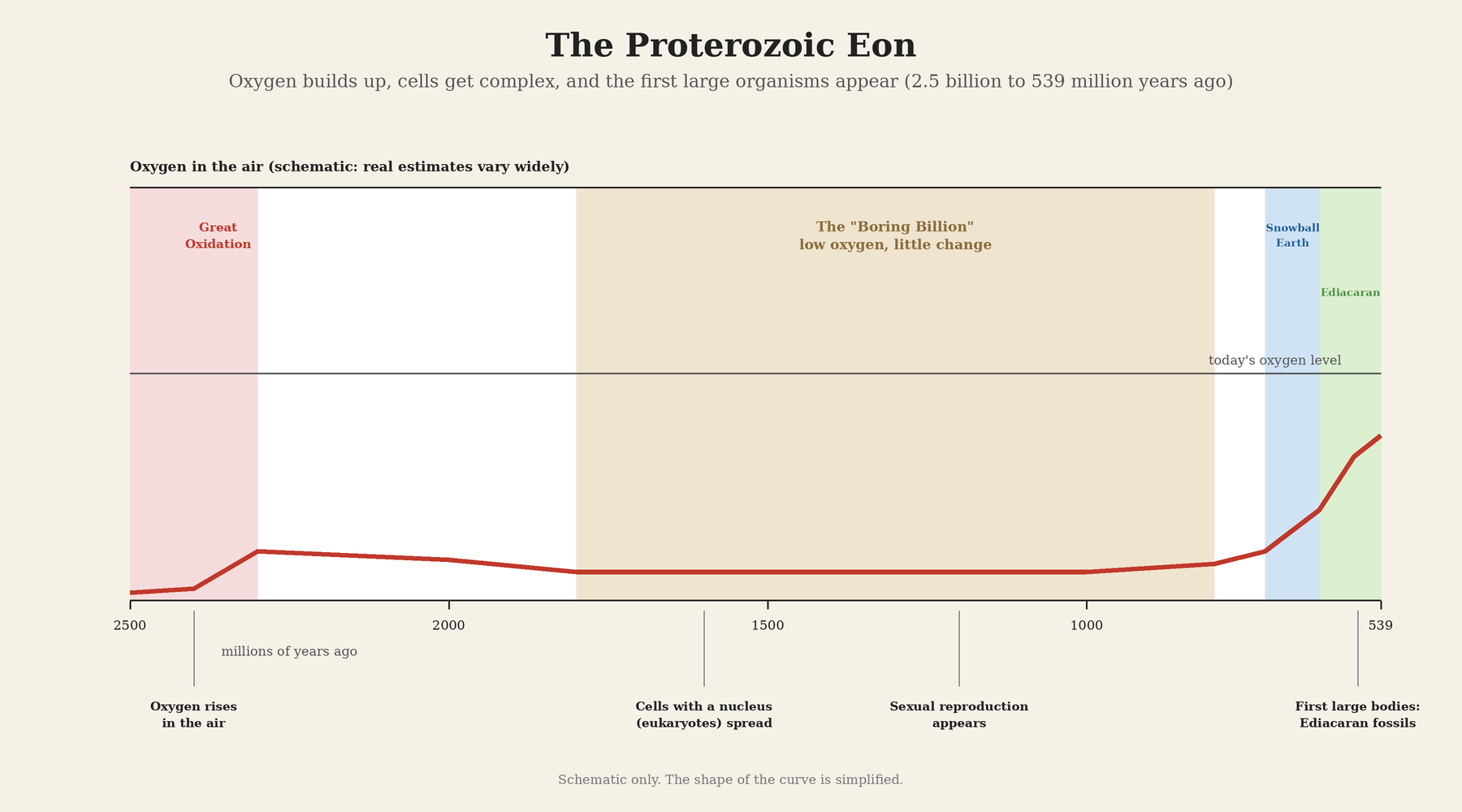
The Proterozoic, meaning “earlier life”, is the longest eon in Earth’s history, lasting almost two billion years. Its great story is oxygen. Photosynthetic bacteria had been releasing it for ages, and around 2.4 billion years ago it finally accumulated in the atmosphere in the Great Oxidation Event. This poisoned many existing microbes but opened the way for energy-rich, oxygen-using life.
Cells with a nucleus, the eukaryotes, appeared perhaps 2 billion years ago, and later some combined into multicellular organisms. The first complex multicellular life, the soft-bodied Ediacaran biota, arose near the end of the eon, around 575 million years ago. Strange frond-like and quilted forms, they had no shells or bones.
The climate swung wildly. During the Cryogenian, around 720 to 635 million years ago, ice may have covered much of the planet in a “Snowball Earth”. Supercontinents such as Rodinia assembled and broke apart.
The Proterozoic has three eras: Paleoproterozoic, Mesoproterozoic and Neoproterozoic. Each era has periods: for example, the Neoproterozoic is split into the Tonian, Cryogenian and Ediacaran. The eon ends with the Cambrian explosion of animal life.
The Great Oxidation
For hundreds of millions of years, cyanobacteria had been releasing oxygen, but it was mopped up by iron in seawater and by volcanic gases. The iron-rich oceans of the Archean rusted. Dissolved iron combined with oxygen, formed insoluble oxides and sank, building the great banded iron formations, layered red and gray rocks that are now mined for most of the world’s iron. Much of the steel in modern buildings and cars began as ancient rust.
Around 2.4 billion years ago, the chemical sinks were saturated, and free oxygen began to accumulate in the air. This is the Great Oxidation Event. Oxygen levels were still only a small fraction of today’s, but the change was enormous. For the anaerobic microbes that dominated the planet, oxygen was a poison, and many were wiped out or driven into oxygen-free refuges such as deep mud and the guts of other organisms. It may have been the greatest pollution crisis in history.
Oxygen also destroyed methane, a powerful greenhouse gas. The result was a severe glaciation, the Huronian, which may have covered much of the planet in ice. Yet the same oxygen enabled a new kind of metabolism that releases far more energy from food. In time, this would make larger and more active life possible.
The Boring Billion
After the upheavals, the middle of the Proterozoic, from about 1.8 to 0.8 billion years ago, appears strangely calm. Scientists call it the “Boring Billion”. Oxygen levels remained low, perhaps one to ten percent of today’s, the climate was relatively stable, and evolution seemed to proceed slowly.
Yet interesting things were happening. Eukaryotes, cells with a nucleus and internal compartments, evolved sometime before 1.6 billion years ago, and possibly much earlier. They are thought to have arisen when one cell engulfed another and the two formed a permanent partnership. The engulfed cells became mitochondria, the energy factories found in nearly all complex cells. Later, a second partnership produced chloroplasts, the structures that carry out photosynthesis in plants and algae.
Sex also appeared. Fossils of red algae about 1.2 billion years old show signs of sexual reproduction, which shuffles genes and speeds up evolution. Meanwhile, the oceans were stratified, with oxygenated surface water above deep layers that held sulfide or iron. The deep sea may have been poisonous for much of this time, limiting where complex life could spread.
Supercontinents
The Proterozoic was an age of assembling and breaking up landmasses. Several supercontinents formed in turn. Columbia, also called Nuna, came together about 1.8 billion years ago. Rodinia assembled around 1.1 billion years ago and began to split apart roughly 750 million years ago. Each supercontinent altered ocean circulation, climate and the chemistry of the seas.
The records of these ancient continents are written in belts of folded and metamorphosed rock, called orogens, which mark the lines where landmasses collided. The Grenville orogeny, which helped build Rodinia, left roots that are visible today in eastern North America, from the Adirondacks to Labrador.
Mountains rose and eroded, delivering nutrients to the seas, and volcanic activity helped to shape the atmosphere. It was a restless world, even if life remained mostly microscopic.
Snowball Earth
Between about 720 and 635 million years ago, in the Cryogenian Period, the world experienced extreme glaciations. Rocks deposited by glaciers appear at places that were near the equator at the time, based on magnetic evidence. This led to the dramatic Snowball Earth hypothesis, which proposes that ice reached the tropics and the ocean froze over almost entirely, possibly more than once.
How could this happen? As ice spread, it reflected more sunlight, cooling the planet further, in a runaway feedback. The breakup of Rodinia may have increased rainfall and weathering, drawing carbon dioxide from the air and weakening the greenhouse effect. The planet could escape the freeze only when volcanoes accumulated enough carbon dioxide to melt the ice, which probably took millions of years. The meltdown was followed by a sultry greenhouse, and deposits of carbonate rock, called cap carbonates, lie directly above glacial deposits, recording the shift.
Some scientists favor a “slushball” version in which patches of open water remained. Either way, the glaciations coincided with a major diversification of complex life, and many researchers see a link. Life that survived the ice might have been pushed toward bigger, multicellular forms.
The Ediacaran World
Following the ice, the final period of the Proterozoic, the Ediacaran, opened about 635 million years ago. It is named after the Ediacara Hills in South Australia, where strange fossils were first found in abundance. They are the oldest large, complex organisms known, and they appear in rocks about 575 million years old.
The Ediacaran biota look unlike almost anything alive today. Some, like Charnia, resembled fern fronds anchored to the seafloor. Others, like Dickinsonia, were flat, ribbed ovals that could grow to more than a meter. There were no shells, no eyes and no obvious mouths. Many probably absorbed nutrients directly from the water or fed on microbial mats. Whether they were early animals, a separate experiment in multicellular life, or something between is debated, and different forms may belong to different groups.
Toward the end of the Ediacaran, burrows and tiny shelled animals such as Cloudina begin to appear, hinting at the first predators and the arms race that would soon follow. Oxygen levels rose in this time, probably enabling bigger bodies.
The Long Prelude
The Proterozoic is easy to overlook because it lacks the drama of dinosaurs. Yet in its two billion years the planet gained an oxygen-rich atmosphere, complex cells, sexual reproduction, multicellular organisms and the first large creatures. Without this eon, the Cambrian would have had nothing to explode from.
Its three eras are the Paleoproterozoic, Mesoproterozoic and Neoproterozoic, and the divisions between them mark broad shifts in how continents and seas behaved. When the Proterozoic ends, at 539 million years ago, the stage is set, and the fossil record is about to become far easier to read.