Cambrian Period (539-487 mya)
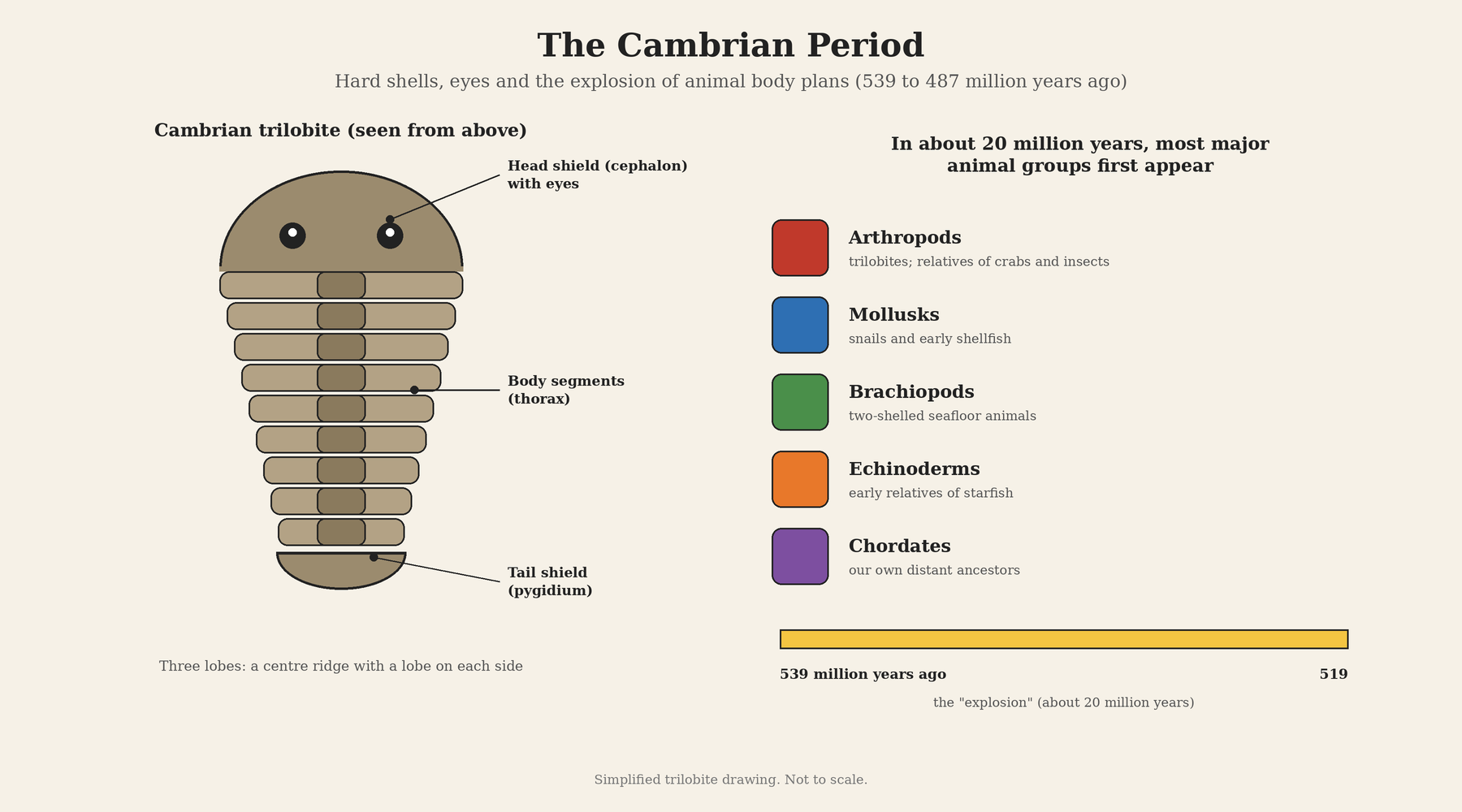
The Cambrian opens the Paleozoic Era and the Phanerozoic Eon. Its start is marked by a burst of evolutionary creativity often called the Cambrian Explosion, when most major animal groups first appear in the fossil record within a few tens of millions of years.
Life was entirely marine. Shallow seas flooded the continents, which were clustered mostly in the Southern Hemisphere around the supercontinent Gondwana. Animals developed hard parts for the first time: shells, spines and armored plates, which fossilize far better than soft bodies.
Trilobites, relatives of modern crabs and insects, became abundant and diverse. Strange predators such as Anomalocaris, a meter-long swimmer with grasping appendages, hunted among the sponges, worms and early mollusks. Sites like the Burgess Shale in Canada and Chengjiang in China preserve astonishing soft-bodied detail.
The earliest chordates, ancestors of all vertebrates, also appeared, tiny and unassuming.
The land remained barren rock and sand, without plants or animals. Oxygen levels were still lower than today, and the climate was generally warm.
The Cambrian ended with a modest extinction event, clearing the way for the next chapter in the story of life.
The Setting
The Cambrian world was very different from ours. The continents were arranged unlike any today, with most land clustered in the southern hemisphere. The great landmass of Gondwana, which would later split into South America, Africa, India, Antarctica and Australia, sat over the south polar region and into the tropics. Smaller continents such as Laurentia, which became North America, Baltica and Siberia lay scattered nearby.
Sea levels were high, and shallow seas spread across the continents. The land itself was lifeless. There was no soil, only bare rock, sand and gravel, and rivers braided across barren plains with no plants to hold the banks. The atmosphere had less oxygen than today but enough to sustain active animals. Temperatures were warm, and there were no polar ice caps for most of the period.
These warm, shallow seas offered ideal conditions for new life, with plenty of habitats and a rising supply of oxygen and nutrients.
The Cambrian Explosion
The Cambrian Explosion is one of the great events in the history of life. Between about 539 and 515 million years ago, nearly all the major body plans of animals first appear in the fossil record. These include the ancestors of arthropods, mollusks, worms, sponges, echinoderms and chordates.
The word “explosion” is somewhat misleading. The event lasted around twenty million years, which is a long time by human standards, and some groups had begun to evolve earlier, in the Ediacaran. But geologically it was fast, and the change from a world of simple soft-bodied organisms to a complex ecosystem is dramatic.
Why did it happen? There is no single answer. Rising oxygen allowed larger, more active bodies. The evolution of predators created an arms race, in which prey developed defenses such as shells and spines, and predators developed better senses and weapons. Genetic toolkits that control body development, such as the Hox genes, had become sophisticated. Changes in ocean chemistry, including more calcium available to build shells, also played a part. Most likely, it was a combination of causes feeding on each other.
Eyes and Armor
Two of the most important innovations were vision and hard parts. Trilobites had some of the earliest sophisticated eyes, made of crystal lenses of calcite. Once animals could see, hunting and hiding became far more important, and the race was on.
Armor appeared in many forms: the shells of brachiopods, the plates of echinoderms, the exoskeletons of arthropods, and the tiny spicules of sponges. Some animals, such as the small shelly fauna, sported minute plates and cones that are found in huge numbers. Hard parts matter to us because they fossilize easily, and so the Cambrian record seems richer than the Ediacaran one. Part of the “explosion” is a result of better preservation, but not all of it. Burrows, tracks and the sudden diversity of body plans show that something real changed.
Animals also began to dig. Before the Cambrian, the seafloor was covered with microbial mats. Burrowers churned the sediment, which mixed oxygen into the mud and ended the mats’ dominance in a change called the Cambrian substrate revolution.
Windows into the Soft-Bodied World
Most animals leave no trace unless they have hard parts, but in a few special places, soft tissue was preserved in remarkable detail. The most famous is the Burgess Shale in the Canadian Rockies, discovered in 1909 by Charles Walcott. It is about 508 million years old. Even older is the Chengjiang biota in Yunnan, China, around 518 million years old, and another important site is the Sirius Passet in Greenland.
These deposits reveal a strange menagerie. Anomalocaris was a predator up to a meter long, with a round mouth lined with plates and two spiny grasping arms. Opabinia had five eyes and a long flexible nozzle with a claw at the tip. Hallucigenia, a spiny worm that walked on pairs of stilts, was first reconstructed upside down. Wiwaxia was covered in scales and spines. Pikaia, a small, eel-like creature, is an early chordate.
Many of these animals were once considered impossibly bizarre. Modern research has shown that most fit into known groups, often as early relatives of living arthropods, worms or other lineages. They are not evolutionary dead-ends but the roots of the family tree.
Trilobites and Their Neighbors
Among the Cambrian’s most common animals were trilobites. Their bodies were divided into three lobes along their length and three sections from head to tail, and they were protected by a hard shell that they shed as they grew. Some crawled across the seafloor, some swam, and some burrowed. Their shells are abundant fossils, and different species lived for short spans, which makes them useful for dating rocks.
They shared the seas with brachiopods, which look like clams but are a different kind of animal, with sponges, archaeocyathids (early reef builders), and early mollusks such as snail-like and tusk-shaped forms. Echinoderms, the group that includes starfish and sea urchins, began to diversify as well.
Our own ancestors were present, though inconspicuous. Chordates such as Pikaia, and early vertebrates such as the small, jawless Haikouichthys from Chengjiang, had a stiffening rod along the back and segmented muscles. They hardly look like the beginnings of a great lineage, but they are.
How the Cambrian Ended
The Cambrian was punctuated by several minor extinction events, often tied to drops in oxygen in the oceans. Trilobites in particular suffered in these crises, and their lineages were repeatedly pruned. The close of the period, about 487 million years ago, saw another decline, with many species vanishing.
The boundary with the Ordovician was chosen based on changes in tiny marine fossils called conodonts, which were among the earliest vertebrate-like animals with hard parts.
Looking back, the Cambrian can be seen as the opening of the Phanerozoic, the age of visible life. It created the template that evolution has been working with ever since. The world was not yet ready for life on land, but the seas were full, and things were about to get much more complex.