Archean Eon (4.0-2.5 bya)
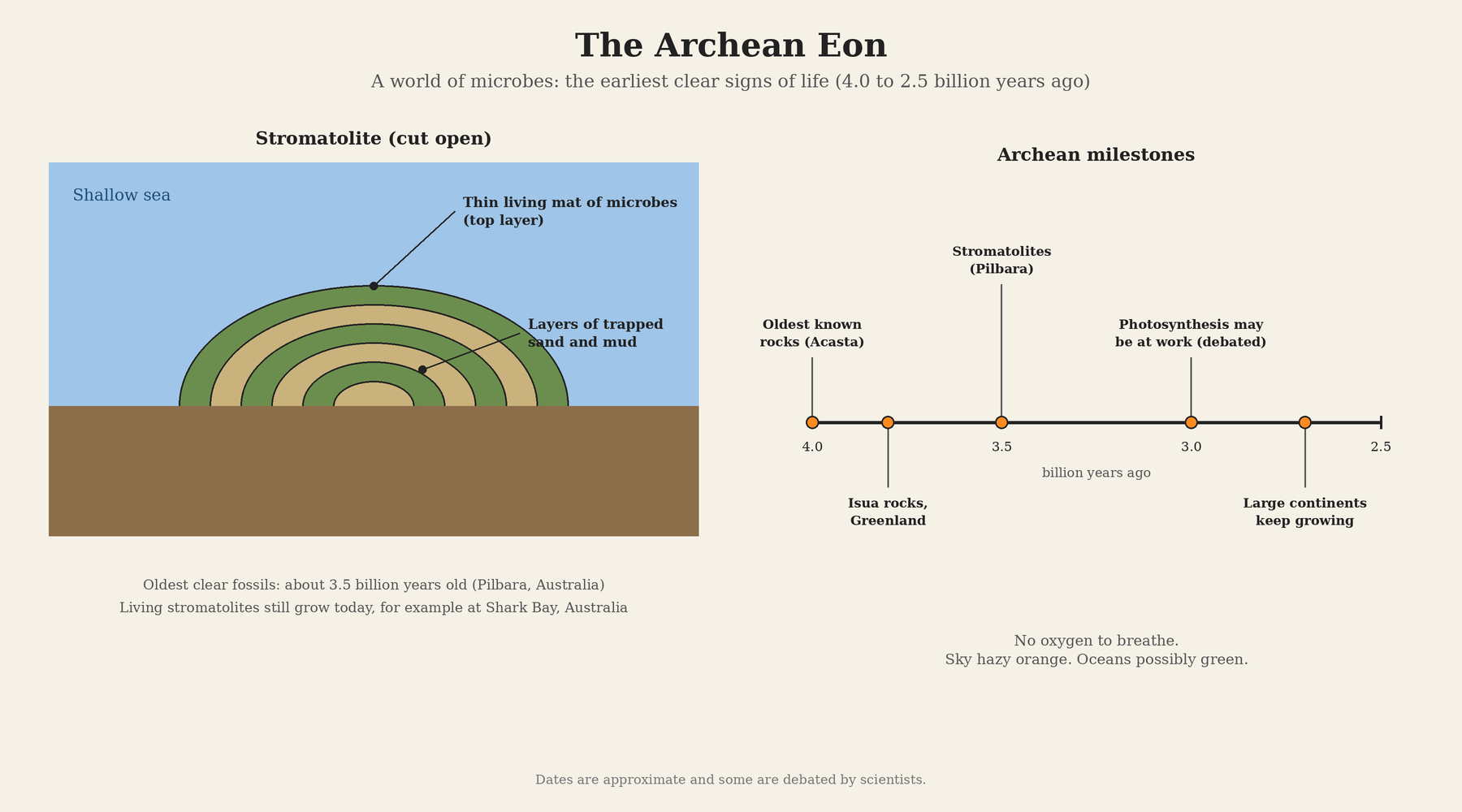
The Archean, meaning “ancient”, is the eon in which life first appears. Earth had cooled enough to hold stable oceans, but the world was still alien. The atmosphere held little or no free oxygen, being mostly nitrogen, carbon dioxide and methane, and the oceans may have looked greenish from dissolved iron.
The oldest known fossils date to at least 3.5 billion years ago: microbial mats and layered structures called stromatolites, built by single-celled organisms in shallow water. Some evidence suggests life may be older still. These microbes were prokaryotes, simple cells without a nucleus. Some eventually evolved photosynthesis, using sunlight to make food and releasing oxygen as waste.
The planet’s interior was hotter than today, and volcanoes were widespread. Small pieces of continental crust, called cratons, formed and grew, becoming the cores of today’s continents. Plate tectonics may have begun during this eon, though scientists still debate when.
The Archean ended about 2.5 billion years ago. It is divided into four eras: Eoarchean, Paleoarchean, Mesoarchean and Neoarchean. Few people ever memorize them, and for most purposes the eon is simply the age of microbes.
A Different World
Imagine standing on the Archean Earth. The sky would not be blue but a hazy orange or greenish tone, thick with methane and carbon dioxide. There would be no oxygen to breathe. The Sun was dimmer, perhaps 75 to 80 percent as bright as today, yet the planet did not freeze, probably because of heat-trapping greenhouse gases. This puzzle, known as the faint young Sun paradox, is one of the long-running questions in Earth science.
The oceans covered most of the surface, with scattered volcanic islands and small patches of continental crust. Because of the high iron content of the water, the seas may have had a green tint. The Moon was still closer than it is now, and tides were stronger. Days lasted perhaps twelve to eighteen hours.
Heat flow from the planet’s interior was several times higher than today, as radioactive elements were more abundant and the planet still retained leftover energy from its formation. Volcanic eruptions of unusual, magnesium-rich lava, called komatiite, were common. Komatiites are almost unknown in later periods because the mantle has cooled since.
The Oldest Rocks
Most Hadean rocks have been destroyed, but the Archean has left us real ones. Among the oldest are the Acasta Gneiss in northern Canada, about 4.0 billion years old, and the Isua Greenstone Belt in Greenland, about 3.8 billion. Rocks at Isua include layers that look like ancient seafloor sediments, and a few researchers have argued they hold chemical traces of life, though this is contested.
Archean rock belts are often called greenstone belts, for the green-tinged volcanic rocks that dominate them, wrapped around bodies of granite. The famous Barberton belt in South Africa and the Pilbara region of Western Australia are two of the best-preserved. Walking across them is like walking across the surface of a young planet.
These rocks formed the cores of the continents, known as cratons. Cratons are thick, stable and old, and they have survived billions of years of drifting and collision. Canada, Australia, South Africa, India and Brazil all have extensive Archean cratons buried or exposed within them.
The First Life
The earliest convincing evidence for life lies in the Pilbara of Western Australia, where rocks about 3.5 billion years old contain stromatolites. These are layered, dome-shaped structures built when mats of microbes trap sediment and bind it together. Living stromatolites still grow in a few warm, salty places, such as Shark Bay in Australia, giving us a window into this ancient world.
Other signs include microscopic filaments in rock that may be fossil cells, and carbon in ancient rock with a chemical signature typical of biological processes. Scientists argue about individual claims, since non-living chemistry can sometimes mimic fossils, but the overall picture is that life was well established by 3.5 billion years ago and perhaps much earlier.
How life began is still unknown. Candidates include hot, mineral-rich vents on the seafloor, shallow tidal pools, or even delivery of organic molecules from space. Whichever it was, the earliest living things were simple, single-celled organisms. They were prokaryotes, lacking a nucleus, and they belonged to two great domains, the bacteria and the archaea. The name Archean is sometimes mistakenly linked to archaea, but the word simply means “ancient”.
Invention of Photosynthesis
Early microbes probably fed on chemical energy, drawing power from reactions with hydrogen, sulfur or iron compounds. Then some learned to use light. The first photosynthesizers did not produce oxygen. They used other raw materials, such as hydrogen sulfide, and released sulfur instead.
The great invention was oxygenic photosynthesis, which uses water as a raw material and releases oxygen. It evolved in the ancestors of cyanobacteria, formerly called blue-green algae. When this happened is debated. Some evidence points to about 3.0 billion years ago or even earlier, while other studies suggest it came closer to the end of the Archean.
The importance of this innovation is difficult to overstate. Water is everywhere, so the supply of raw material was effectively limitless. Cyanobacteria could spread across the oceans, and over the following eons, they changed the chemistry of the whole planet. Yet for a long time the oxygen they produced did not build up in the air. It was absorbed by dissolved iron in the sea and by volcanic gases, a vast sink that took a long time to fill.
Continents, Crust and Tectonics
When did plate tectonics begin? This is a major open question. Today, Earth’s outer shell is broken into plates that move, collide and slide beneath each other, recycling the crust. In the early Archean, the crust may have been too hot and weak for this style of tectonics. Some researchers imagine a “stagnant lid” with the crust acting as a single, buckling skin, punctuated by plumes of hot rock rising from below.
Others find evidence of modern-style plate movement by 3.2 billion years ago or even before. The question is hard because so little rock survives and the evidence can be read in different ways. Most agree that by the end of the Archean, around 2.7 billion years ago, large continents were growing and plate tectonics resembled today’s.
Whatever the details, continental crust grew substantially during this eon. Granite, a light rock, formed from melting of older material, and it floated on the denser mantle. Estimates suggest that at least half of the continental crust that exists today had formed by the end of the Archean.
Four Eras, One Story
The Archean is subdivided into four eras: the Eoarchean, Paleoarchean, Mesoarchean and Neoarchean. They are defined by round-number ages rather than by changes in the rocks, a reflection of how little there is to go on. Each lasts several hundred million years.
The eon closes about 2.5 billion years ago with a planet that has changed profoundly. It has oceans, continents, active tectonics, and life that has spread through the seas. Though no animal, plant or fungus exists, the biosphere is thriving in its own microbial way. Oxygen is still scarce in the air, but it is on the verge of a revolution.
The story of the Archean is a reminder that life is old, much older than anything with a shell, a bone or a leaf. For roughly half of Earth’s entire history, microbes were the only inhabitants, and they quietly laid the groundwork for everything that followed.