Carboniferous Period (359-299 mya)
The Carboniferous takes its name from the huge coal beds formed during this time. Warm, wet, swampy lowland forests covered much of the tropics, filled with giant club mosses, horsetails and tree ferns. When these plants died, they accumulated in waterlogged ground and eventually became coal, which later fueled the Industrial Revolution.
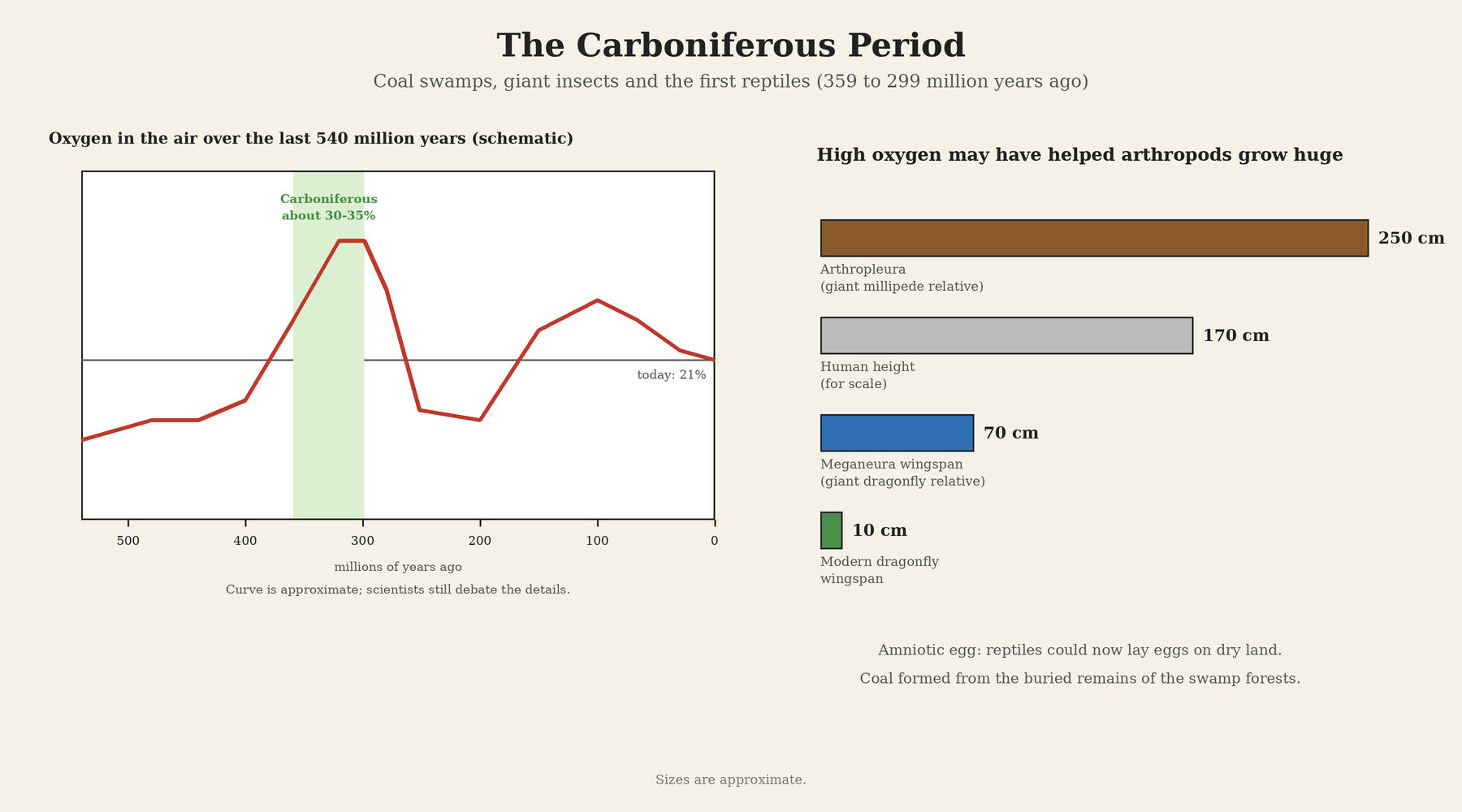
Oxygen reached about 35 percent of the atmosphere, compared with 21 percent today. Combined with abundant plant life, this may have helped arthropods grow enormous. Meganeura, a dragonfly relative, had a wingspan of about 70 centimeters, and the millipede-like Arthropleura grew over two meters long.
Amphibians dominated the land and waters. Then a major innovation arrived: the amniotic egg, with a protective shell and membranes that let animals reproduce away from water. The first reptiles evolved, and with them the lineages that would lead to dinosaurs, birds and mammals.
Toward the end of the period, the continents collided to form the supercontinent Pangaea, and the climate became cooler and drier. Ice sheets expanded in the south, and the great tropical swamps began to shrink.
Two Names, Two Halves
In North America, the Carboniferous is split into two separate periods: the Mississippian (early) and the Pennsylvanian (late). The names come from the Mississippi River valley, whose rocks are mostly marine limestone, and the state of Pennsylvania, whose rocks hold rich coal seams. Elsewhere in the world, the two are treated as epochs of one period, the Carboniferous. The difference reflects the way the world changed: seas dominated the early part, and swamps and forests dominated the later.
At the start, the climate was warm and wet, and shallow seas covered much of the continents. Corals and crinoids built vast limestone deposits. As the period progressed, the continents moved together, sea levels fell, and the climate began to cool.
The Coal Forests
The Pennsylvanian is the time of the great coal swamps. Low-lying tropical regions in what is now eastern North America, Europe and China were covered by waterlogged forests unlike any today. The trees were not conifers or oaks but giant relatives of modern club mosses and horsetails.
Lepidodendron, the “scale tree,” soared up to 30 or 40 meters, with a trunk covered in diamond-shaped leaf scars and a crown of forked branches. Sigillaria had a tall fluted trunk with tufts of long leaves. Calamites, a giant horsetail, grew in dense stands along waterways. Tree ferns and seed ferns filled the understory.
When these plants died and fell into stagnant water, there was too little oxygen for them to decay fully. Layer upon layer of partially decayed plant matter built up as peat, and later burial, heat and pressure turned it into coal. Because the trees’ bark held lignin that few organisms could break down at that time, many scientists suggest the accumulation was especially strong. This is debated, as fungi that digest lignin may have evolved earlier than previously thought.
Much of the energy that powered the Industrial Revolution, in Britain, Germany, the United States, China and elsewhere, is stored sunlight from these ancient swamps.
A High-Oxygen World
The sheer volume of plant growth and the burial of so much carbon had an effect on the atmosphere. Oxygen levels climbed to perhaps 30 to 35 percent, the highest of the past 500 million years. Today they are 21 percent.
High oxygen had two consequences. It made wildfires much more frequent and fierce, and charcoal is common in Carboniferous coal. And it may have helped arthropods, which breathe through tubes and diffusion rather than lungs, to grow enormous. Oxygen is often linked to the largest insects that ever lived, though scientists still debate this: some giants, such as Arthropleura, seem to have reached their size before oxygen peaked.
Carbon dioxide fell at the same time. With so much carbon locked up in coal and wood, the greenhouse effect weakened, and the climate cooled. By the late Carboniferous, large ice sheets covered the southern part of Gondwana, and the planet entered the Late Paleozoic Ice Age, which would last into the Permian.
Giants of the Undergrowth
The arthropods of this time included some of the most impressive land invertebrates ever. Meganeura, a griffinfly related to dragonflies, had a wingspan of about 70 centimeters, as big as a modern hawk. Arthropleura was a giant relative of millipedes that grew to over 2.5 meters long, probably feeding on plant matter and rotting wood. Scorpions reached half a meter or more, and spiders and cockroaches scuttled across the forest floor.
Insects themselves were undergoing a revolution. Winged insects, now well established, could fly, giving them a major advantage in finding food and escaping predators. Some groups developed the ability to fold their wings back over their body, and others began a pattern of complete metamorphosis, which would later lead to beetles, flies, butterflies and bees.
The seas were also busy. Sharks diversified, including bizarre forms like Helicoprion, with a spiral of teeth, and Stethacanthus, with an anvil-shaped fin on its back. Crinoids and brachiopods thrived, and foraminifera, tiny shelled single-celled creatures, spread widely.
Amphibians and the First Reptiles
On land, the tetrapods that had emerged in the Devonian diversified into many types of amphibians. Some were small and salamander-like, while others were large crocodile-like predators such as Eogyrinus, which could reach 4.5 meters. They lived mostly in or near the swamps and rivers, and most had to return to water to lay their eggs, as modern amphibians do.
The great innovation was the amniotic egg. This egg has a shell or leathery membrane and several internal membranes, enclosing a private pond for the embryo. It allowed animals to lay eggs on dry land and break the tie with water, opening the continental interiors to vertebrates.
The earliest known amniote, Hylonomus, is found in fossilized tree stumps in Nova Scotia, dated to about 312 million years ago. It was a small, lizard-like creature, around 20 centimeters long, that fed on insects and millipedes. From such animals came two great lineages: the sauropsids, which include reptiles, dinosaurs and birds, and the synapsids, which include mammals and their ancestors. Every bird, crocodile, lizard, cat and human descends from creatures like these.
Collision of Continents
During the Carboniferous, the continents were converging. Laurussia collided with Gondwana, closing the Rheic Ocean and raising a vast mountain chain. Its remnants include the Appalachians, the Ouachitas and the Variscan mountains of Europe. By the end of the period, nearly all landmasses were joined into the supercontinent Pangaea.
The assembly of Pangaea changed ocean circulation and climate. The mountain chains diverted rain and winds. Glaciers expanded over the southern continents, causing sea level to rise and fall in cycles as ice grew and melted. These cycles are recorded in the repeated layers of coal, sandstone and marine limestone called cyclothems, found across the central United States.
The Rainforest Collapse
Near the end of the Carboniferous, about 305 million years ago, the great coal forests suffered a sudden collapse, known as the Carboniferous Rainforest Collapse. Climate became cooler and drier, and the tropical rainforests fragmented into isolated patches. The giant club mosses were hit hardest and largely disappeared.
Amphibians that depended on the damp swamps suffered, but reptiles, with their waterproof eggs and skin, were better suited to the new dry conditions. They diversified and began to take over. Seed plants, such as conifers, also gained ground.
The Carboniferous closed with the world drying out and warming up. The tropical swamps had done their work, burying carbon and powering a future industrial age, and the stage was set for the reptile-dominated Permian.