Paleogene Period (66-23 mya)
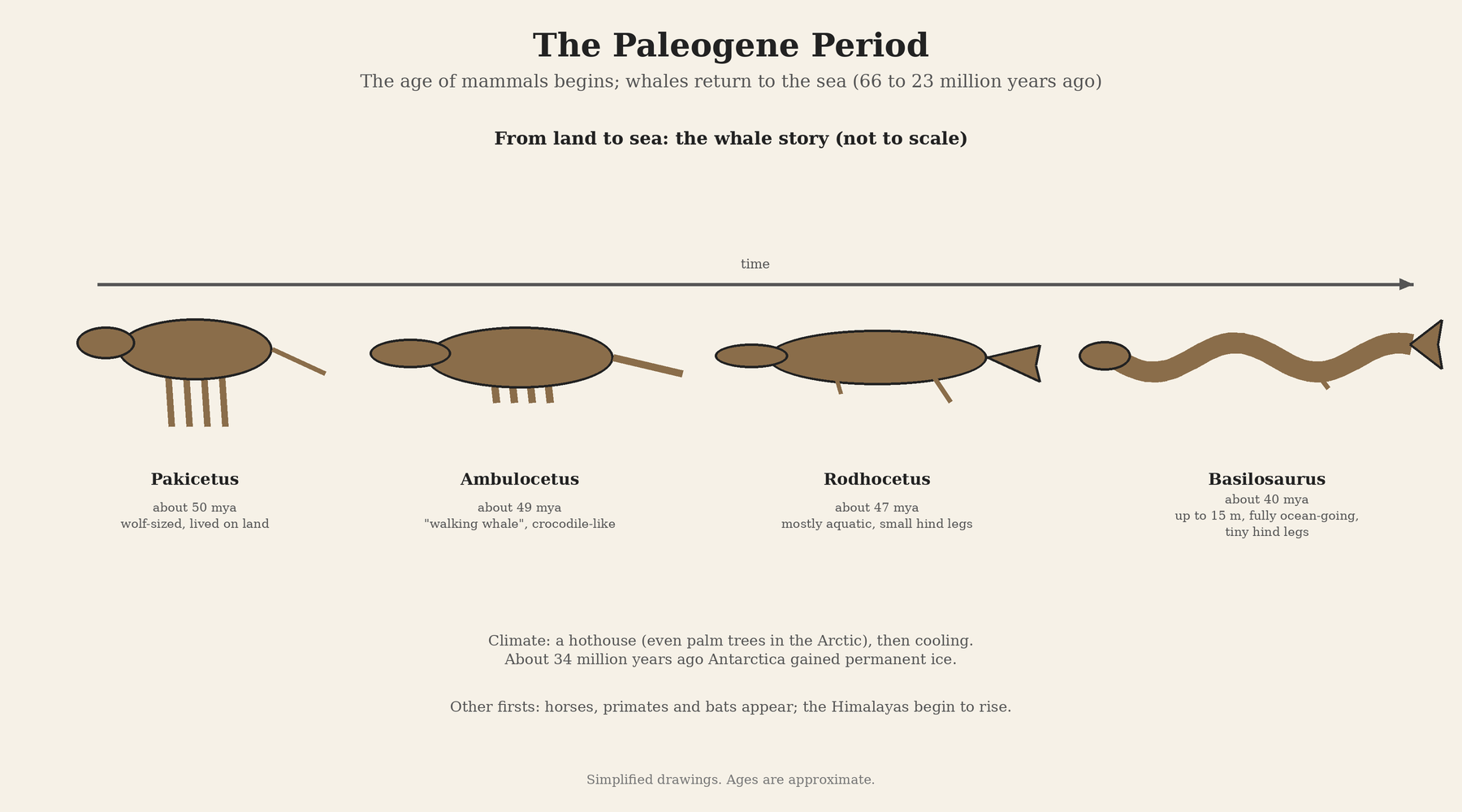
The Paleogene opens the Cenozoic Era, the “age of mammals.” With the dinosaurs gone, surviving mammals rapidly expanded into every empty niche, and within a few million years they had evolved into a spectacular variety of forms.
Early on, the world was warm. Around 56 million years ago, a sudden warming event called the Paleocene-Eocene Thermal Maximum made the planet even hotter, and rainforests stretched to high latitudes. Primates, horses, whales, bats and many modern mammal groups first appear. Early whales such as Pakicetus were land animals that gradually returned to the sea. Birds also diversified, including large flightless predators.
Later in the period, the climate cooled. Antarctica separated from South America and became isolated, developing a permanent ice sheet about 34 million years ago. Forests shrank and open grasslands began to spread. The Indian subcontinent collided with Asia, beginning the uplift of the Himalayas.
The Paleogene is divided into three epochs: Paleocene, Eocene and Oligocene. By its end, the world looked recognizably modern, with Earth’s continents close to their present positions.
Recovery from Catastrophe
In the first days after the asteroid struck, the world was a smoldering, darkened wasteland. Yet recovery began astonishingly quickly. Fossils from the Corral Bluffs in Colorado show that plants and mammals rebounded within about a million years. Ferns were the first to spread, followed by palms and other flowering plants, and then new kinds of forest.
The Paleogene is divided into three epochs: the Paleocene (66 to 56 million years ago), the Eocene (56 to 34 million years ago) and the Oligocene (34 to 23 million years ago). The names, from Greek, mean roughly “old recent,” “dawn recent,” and “few recent,” a reference to the proportion of modern species found in the rocks.
Early on, the main survivors were small. But with large dinosaurs gone, there was suddenly room for new body sizes. Within a few million years, mammals had evolved into a range of forms from tiny insect-eaters to large, heavy herbivores.
Birds and Reptiles Fill the Gap
Mammals did not take over everything right away. In the early Paleogene, large flightless birds were among the top predators. The “terror birds” (phorusrhacids) of South America, such as Kelenken, stood up to 3 meters tall with huge hooked beaks, and hunted mammals. In the Northern Hemisphere, Diatryma (also known as Gastornis) was a stocky, flightless giant, probably a plant-eater.
Reptiles did well, too. The enormous snake Titanoboa, from the Paleocene of Colombia, was around 13 meters long and weighed over a tonne, living in a steamy rainforest. Crocodiles ranged much more widely than today. Their presence in Arctic deposits shows how warm the climate had become.
Meanwhile, modern birds were diversifying quickly. Owls, parrots, penguins, hummingbirds and songbirds all trace their origins to this time.
The Hothouse
The warmest moment since the Cretaceous came about 56 million years ago. In an event called the Paleocene–Eocene Thermal Maximum (PETM), a huge amount of carbon was released into the atmosphere within a few thousand years, possibly from volcanic activity, methane hydrates or burning peat. Global temperatures rose by about 5 to 8 degrees Celsius.
The effects were dramatic. Oceans became acidic, and many deep-sea organisms went extinct. Plants and animals migrated toward the poles. Mammals, in response, shrank in size, and the earliest primates, horses and hoofed mammals appeared on the northern continents, perhaps encouraged by the warmth.
The PETM lasted perhaps 150,000 to 200,000 years before the climate recovered. Because the amount of carbon released is comparable to what humans may emit, scientists study it closely as a natural experiment.
During the following Eocene, the warm climate persisted. Rainforests grew near the poles, and palm trees and alligators lived on Ellesmere Island in Arctic Canada. Fossil lakes in Wyoming and Germany preserve a rich array of fishes, insects, birds and mammals, including bats and early horses.
Whales Return to the Sea
One of the best-documented evolutionary transitions occurred in the Eocene. Whales descend from small, hoofed land mammals related to hippos and deer, and a series of fossils from Pakistan, India and Egypt traces their path back to the water.
Pakicetus, about 50 million years old, looked like a wolf-sized land animal, though its ear bones show whale traits. Ambulocetus, “walking whale,” had strong legs and a long snout, and probably ambushed prey in shallow water like a crocodile. Rodhocetus and Dorudon were fully aquatic, with reduced hind limbs. At Wadi Al-Hitan in Egypt, the “Valley of Whales,” skeletons of Basilosaurus, a 15-meter serpentine whale with tiny hind legs, lie on the desert sand.
By the end of the Eocene, whales had become fully ocean-going animals. Sirenians, the group of manatees and dugongs, made a similar move, and bats took to the air.
The Cooling
The warm greenhouse did not last. Over the Eocene, carbon dioxide levels gradually fell, and Earth began to cool. A key event happened around 34 million years ago, at the boundary between the Eocene and Oligocene, when Antarctica developed permanent ice sheets.
Antarctica had been drifting toward the pole and had become isolated as Australia and South America moved away. The Antarctic Circumpolar Current formed, a ring of cold water circulating around the continent that kept warm water away. Declining carbon dioxide made the ice sheet possible. The transition ranks among the biggest climate shifts of the past 66 million years, and it caused sea levels to drop and a wave of extinctions, particularly in Europe, known as the “Grande Coupure”.
The Oligocene was cooler and drier. Forests thinned, and open woodlands and early grasslands began to expand. Mammals evolved longer legs and high-crowned teeth for grazing.
Giants of the Oligocene
Land mammals grew large. Paraceratherium, a hornless rhinoceros relative from Asia, is the largest land mammal that ever lived, standing around 5 meters at the shoulder and weighing perhaps 15 to 20 tonnes. It browsed treetops like a giant giraffe. Brontotheres, with horns like a forked Y on their noses, roamed North America. The entelodonts, nicknamed “hell pigs,” were fierce omnivores.
Predators included hyena-like creodonts and the first true carnivorans, the group including dogs, cats and bears. Primates diversified, and in Africa, early monkeys and apes emerged, which would lead eventually to us.
Mountains and Moving Continents
Plate tectonics reshaped the world. India, traveling north as an island since the Cretaceous, collided with Asia around 50 million years ago, and the crumpling raised the Himalayas and the Tibetan Plateau. Their weathering absorbed carbon dioxide and may have contributed to the long-term cooling.
The Alps rose as Africa pressed northward into Europe, and the Rocky Mountains underwent further uplift in North America. The Atlantic continued to widen, and the continents slowly assumed their modern outlines. By the end of the Paleogene, the stage was set: open grasslands were spreading, and the age of the mammals was well underway.