Neogene Period (23-2.6 mya)
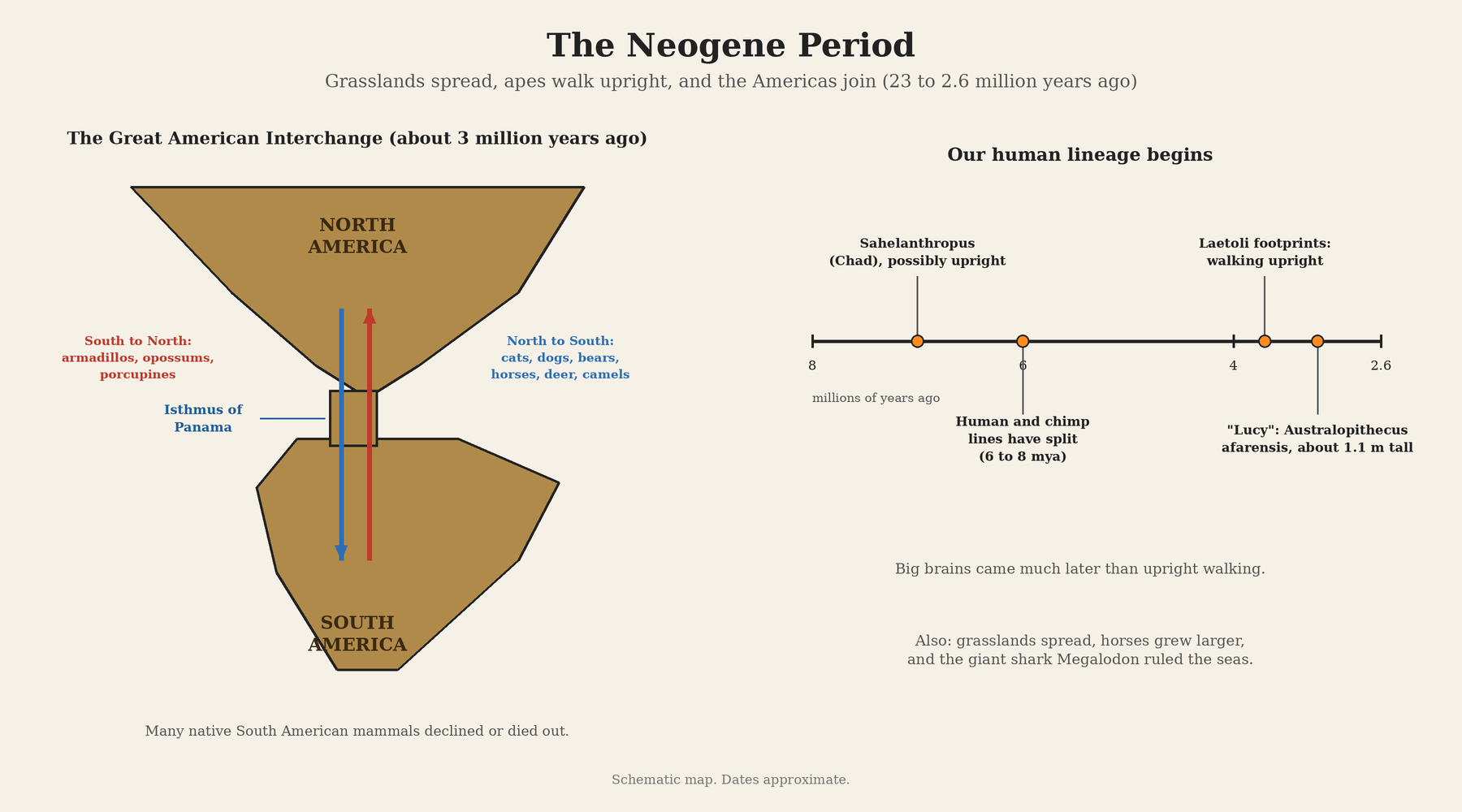
The Neogene brought the world much closer to the one we know. Continents were almost in their current places, and the climate continued its long cooling trend, interrupted by warmer spells. Grasslands expanded across continents, and grazing animals such as horses, antelope and early elephants thrived on them.
Mammals reached enormous sizes, including elephant relatives such as mastodons and, later, mammoth ancestors. (The huge rhinoceros relative Paraceratherium had died out just as the period began.) In the seas, the giant shark Megalodon ruled, growing up to around fifteen meters long, while whales and seals became more diverse.
For us, this was a crucial time. Apes diversified in Africa and Eurasia during the Miocene epoch. Around six to seven million years ago, the human lineage split from the one leading to chimpanzees. By the Pliocene, our early ancestors, the australopithecines such as “Lucy,” were walking upright on two legs in East Africa.
Late in the period, the Isthmus of Panama closed, linking North and South America. This redirected ocean currents and allowed animals to cross between the continents in the Great American Interchange, shaping the climate and wildlife of both.
The Modern World Takes Shape
The Neogene is divided into the Miocene (23 to 5.3 million years ago) and the Pliocene (5.3 to 2.6 million years ago). During these 20 million years, the continents moved to within a few hundred kilometers of their present positions, and the broad pattern of the modern world emerged: its mountain chains, ocean currents, deserts and climate zones.
The Miocene began warm, with a peak around 16 million years ago called the Mid-Miocene Climatic Optimum. After that, a long cooling trend set in. Antarctic ice grew, and later in the period the Arctic began to freeze, too. By the Pliocene, polar ice caps were established, and the stage was set for the ice ages of the Quaternary.
Several events changed regional climates. India’s continuing push into Asia raised the Himalayas and Tibetan Plateau even higher, intensifying the Asian monsoon and drying Central Asia. The Rocky Mountains and Andes also rose, creating rain shadows. In East Africa, rifting and uplift altered the rainfall patterns and created a mosaic of forests and savannas.
The Spread of Grasslands
The most important change on land was the spread of grasses. Grasses had been around since the Cretaceous, but only in the Miocene did they come to dominate large areas. As the climate dried and cooled, open grasslands replaced forests across North America, Eurasia, Africa and South America.
Grasses evolved a new way of photosynthesis, called C4 photosynthesis, which works better in hot, dry conditions and low carbon dioxide. By around 8 million years ago, C4 grasses were spreading rapidly, as seen in the carbon chemistry of fossil teeth and soils.
Grazing animals evolved to match. Horses, which began in the Eocene as small forest browsers, grew larger and developed single toes and high-crowned teeth that could withstand abrasive, silica-filled grass. Antelope, bison ancestors, deer, camels and rhinoceroses all radiated. In turn, predators, from sabertoothed cats to bear-dogs, evolved to hunt them. Grassland is among the most extensive habitats in the world today, and it’s a product of this time.
Giants of the Land and Sea
Mammals were large and varied. Elephants spread from Africa into Eurasia and the Americas. Among them were the four-tusked gomphotheres and the shovel-tusked Platybelodon. Giraffe relatives, huge rhinoceroses, and giant ground sloths in the Americas filled the landscape. Australia had its own giants: marsupial relatives of wombats and kangaroos grew to rhinoceros size, a group whose best-known member, Diprotodon, appeared about 1.6 million years ago and survived into the Quaternary.
The seas had equally huge animals. The great shark Otodus megalodon, which lived from about 23 to 3.6 million years ago, is estimated at 15 meters or more, with teeth over 15 centimeters long. It fed on whales and other large marine animals. Baleen whales, dolphins, seals and sea lions diversified, and many modern whale groups emerged. Giant whales, such as the 17-meter Livyatan, had huge teeth and hunted other whales.
Megalodon vanished during the Pliocene, probably due to cooling oceans and a decline in prey, as well as competition from other predators such as the great white shark.
Apes and the Human Lineage
The Miocene is sometimes called the “Age of Apes.” In forests of Africa, Europe and Asia, dozens of ape species lived. Most were tree-dwelling fruit-eaters, but they varied greatly. Monkeys, which had arisen earlier, also thrived.
As Africa dried, forests broke into patches. Some apes adapted to life on the ground and at the forest edge. Based on genetic evidence, the lineage leading to humans diverged from that leading to chimpanzees and bonobos around 6 to 8 million years ago. Early candidates for human relatives include Sahelanthropus from Chad (around 7 million years old), Orrorin from Kenya and Ardipithecus from Ethiopia. They show signs of walking upright on two legs.
In the Pliocene, the australopithecines flourished. The most famous fossil, “Lucy,” a 3.2-million-year-old Australopithecus afarensis skeleton found in Ethiopia in 1974, stood about 1.1 meters tall. She walked upright, but she also had long arms and curved fingers, indicating she still climbed trees. Footprints at Laetoli in Tanzania, 3.7 million years old, show that upright walking was well established. Bipedalism came before large brains, which expanded much later.
A Dry Mediterranean
One of the strangest events of the Neogene occurred at the end of the Miocene. Between about 5.96 and 5.33 million years ago, the Mediterranean Sea was cut off from the Atlantic when the Strait of Gibraltar closed, probably by tectonic uplift. This episode is called the Messinian salinity crisis.
Cut off from the ocean, and with evaporation exceeding river input, the Mediterranean shrank dramatically and became a series of salty lakes and vast salt flats. Thick deposits of salt, up to two kilometers thick, now lie beneath the Mediterranean floor. It is debated how completely the sea dried up and how quickly.
The crisis ended with the Zanclean flood, when the Atlantic broke through the barrier at Gibraltar and refilled the basin, possibly in a matter of months to a few years, in one of the most spectacular floods in Earth’s history.
The Land Bridge
In the Pliocene, around 3 million years ago, the Isthmus of Panama finally closed. (Scientists still debate the timing: some evidence points to an earlier, gradual closure, with the final land bridge complete by about 3 million years ago.) Volcanic arcs and uplift had been raising land from the sea for millions of years, and eventually a continuous bridge connected North and South America.
The effect was huge. Ocean currents changed: the Atlantic and Pacific were separated, strengthening the Gulf Stream and changing climate in the North Atlantic. Some scientists think this helped trigger the northern ice sheets by increasing moisture.
On land, the Great American Biotic Interchange began. South America had been isolated for tens of millions of years, evolving its own mammals, including giant ground sloths, armadillos, glyptodonts and opossums. Now North American animals such as cats, dogs, bears, horses, camelids and deer moved south, and some southern forms went north, including armadillos, porcupines and opossums. Many native South American mammals declined or went extinct, because northern immigrants proved more competitive.
The Neogene ended with the world cooler, drier, and increasingly ruled by ice, a world that would be defined by the great glaciations of the Quaternary.