Cretaceous Period (145-66 mya)
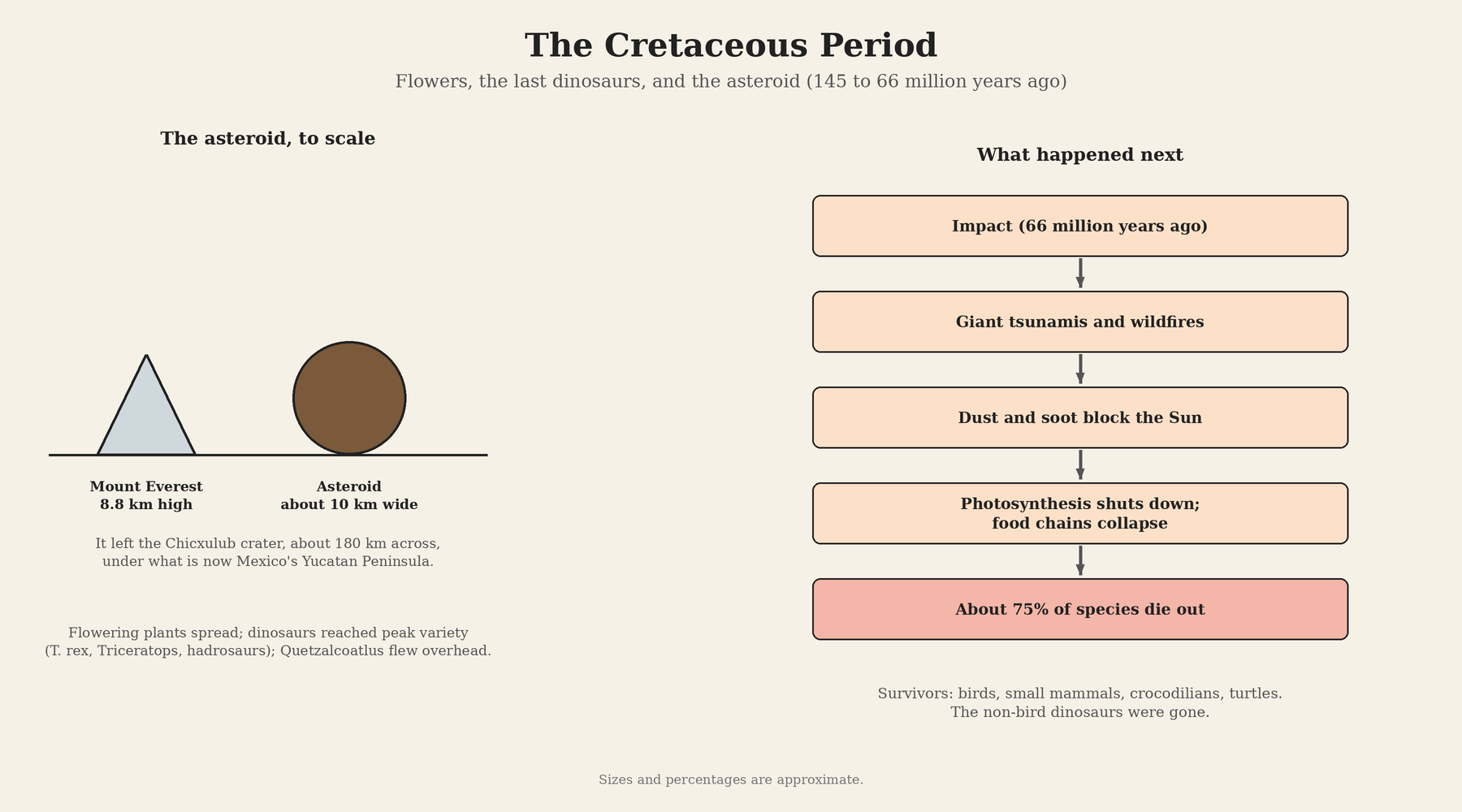
The Cretaceous was the longest period of the Mesozoic, lasting about 79 million years. Its name comes from the Latin for chalk, referring to the white chalk cliffs, built from the tiny shells of marine plankton, that formed in warm seas. Sea levels were very high, and the climate was hot, with no polar ice caps.
Flowering plants, the angiosperms, appeared and spread rapidly, transforming landscapes and bringing along bees, butterflies and many other insects. Dinosaurs reached peak diversity. Tyrannosaurus, Triceratops and the duck-billed hadrosaurs lived at the end, while feathered dinosaurs and early birds flourished. Mammals stayed mostly small, though marsupials and placental mammals emerged.
In the oceans, mosasaurs and giant sea turtles were the top predators, and pterosaurs such as Quetzalcoatlus flew overhead.
The period ended abruptly 66 million years ago. A massive asteroid, about ten kilometers wide, struck near what is now the Yucatan Peninsula in Mexico, probably aided by huge volcanic eruptions in India. Dust and debris darkened the sky, temperatures crashed and about 75 percent of species died. All non-avian dinosaurs perished; only birds survived, and the age of mammals could begin.
The Greenhouse World
The Cretaceous was the warmest period of the Phanerozoic. Carbon dioxide levels were several times higher than today, perhaps because of increased volcanic activity associated with the rapid spreading of the seafloor. Temperatures peaked in the mid-Cretaceous, about 90 million years ago, when tropical sea surfaces may have reached 35 degrees Celsius, and there were no permanent ice caps. Crocodile relatives and dinosaurs lived in polar regions, which had cooler but ice-free climates.
Sea levels were the highest of any time in the Phanerozoic, perhaps 200 meters above the present. A huge inland sea, the Western Interior Seaway, divided North America into two landmasses, east and west, stretching from the Arctic to the Gulf of Mexico. The continents drifted toward their modern places: the Atlantic widened, South America split from Africa, and India raced north as an island.
Warm, shallow seas favored tiny plankton with shells of calcium carbonate, such as coccolithophores. When they died, their shells piled up in enormous thicknesses, forming chalk, which gives the Cretaceous its name. The White Cliffs of Dover are a famous example.
The Flowering Revolution
Perhaps the most significant change on land was the rise of flowering plants, or angiosperms. The oldest convincing fossils date to the Early Cretaceous, around 130 million years ago, though molecular evidence hints that the group may be older. Darwin called their sudden appearance an “abominable mystery.”
By the end of the period, flowering plants had become the dominant plants in most habitats, including magnolias, willows, oaks, palms and the first grasses. Their success lay in their flowers, which attract insects to carry pollen, and in their fruits and seeds. They also grew and reproduced faster than conifers and ferns.
The flowering plants drove an explosion of insect diversity. Bees evolved from wasps, butterflies and moths appeared, and ants and termites became social. Plants and pollinators coevolved, producing the intricate relationships we see now. The Cretaceous is a time when the modern world of flowers and insects was born.
The Last Dinosaurs
Dinosaurs reached their greatest diversity in the Cretaceous. In the early period, there were still sauropods and large predators like Spinosaurus, a fish-eater with a sail on its back that could exceed 14 meters, and probably spent much time in water. Plant-eaters such as Iguanodon, one of the first dinosaurs ever described, roamed in herds.
In the Late Cretaceous, the duck-billed hadrosaurs, such as Edmontosaurus, formed huge herds, supported by batteries of hundreds of grinding teeth. Horned ceratopsians, like Triceratops and Styracosaurus, evolved elaborate frills and horns. Armored ankylosaurs sported clubbed tails. Titanosaurs, the last great sauropods, flourished in the southern continents, and some, like Argentinosaurus, are the heaviest land animals known.
The top predators included Tyrannosaurus rex, which was up to 12 meters long with a bite force of over 6 tonnes, and its relatives. In Asia, Velociraptor and its kin were small, feathered hunters. Many dinosaurs, including these dromaeosaurs, had feathers.
Birds were evolving, too. Confuciusornis and the toothed Hesperornis and Ichthyornis show the early diversity of birds. The first modern birds appeared before the end.
Seas and Skies
The Cretaceous seas were filled with specialized reptiles. The giant mosasaurs, relatives of monitor lizards, rose to dominance in the Late Cretaceous, with Mosasaurus reaching 15 meters. Plesiosaurs such as Elasmosaurus had necks as long as their bodies. Huge sea turtles like Archelon grew to four meters. Ichthyosaurs, in decline, went extinct about 90 million years ago.
Sharks, including the ancestor of the great white, and bony fishes swarmed in the seas. Ammonites reached their last great diversity, and rudist clams built reefs in the place of corals.
Pterosaurs reached huge sizes. Quetzalcoatlus, with a wingspan of 10 to 11 meters, was the largest flying animal ever, standing as tall as a giraffe on the ground, and it probably hunted on land. As birds took over the skies, small pterosaurs declined.
Mammals in the Margins
Mammals remained small but diverse. Multituberculates, rodent-like plant-eaters, were abundant and successful, lasting more than 100 million years. Early marsupials and placental mammals appeared, and a few mammals grew to substantial size. Repenomamus, from China, was a badger-sized predator that ate young dinosaurs.
The ancestors of the groups that would inherit the Earth were present, living in burrows and trees, and many were probably nocturnal. They survived what was coming largely because they were small.
The Impact
About 66 million years ago, an asteroid roughly 10 kilometers wide hit the coast of what is now the Yucatan Peninsula in Mexico. It formed the Chicxulub crater, about 180 kilometers across. The evidence includes a thin layer of clay rich in iridium, a metal common in asteroids and rare in Earth’s crust, found around the world. It was discovered by Luis and Walter Alvarez in 1980. Shocked quartz, glassy spherules and the buried crater itself have confirmed it.
The impact released energy equal to billions of nuclear bombs. It triggered giant tsunamis, wildfires, and an enormous cloud of dust and soot that blocked sunlight for months or years. Photosynthesis shut down, food chains collapsed from the bottom, and temperatures fell. Sulfur released from the target rocks may have caused acid rain and long-lasting cooling.
At the same time, massive volcanic eruptions were building the Deccan Traps in India. Their contribution to the extinction is debated, and some scientists suggest they stressed the environment before the impact. Most agree that the asteroid was the main cause.
The End of an Age
About 75 percent of all species perished. All dinosaurs, except the birds, vanished. So did pterosaurs, mosasaurs, plesiosaurs, ammonites and many plankton groups. Survivors tended to be small, able to burrow or shelter, or to eat seeds and detritus, which could outlast the darkness. Birds with beaks that could crack seeds made it through, and so did small mammals, crocodilians, turtles and amphibians.
A clear line in the rocks, the K–Pg boundary, marks the change. Below it lie the fossils of the Mesozoic. Above it, a new world begins. The extinction cleared away the dominant animals, and gave the surviving mammals the chance to rise. Without that asteroid, humans would almost certainly not exist.