Quaternary Period (2.6 mya-today)
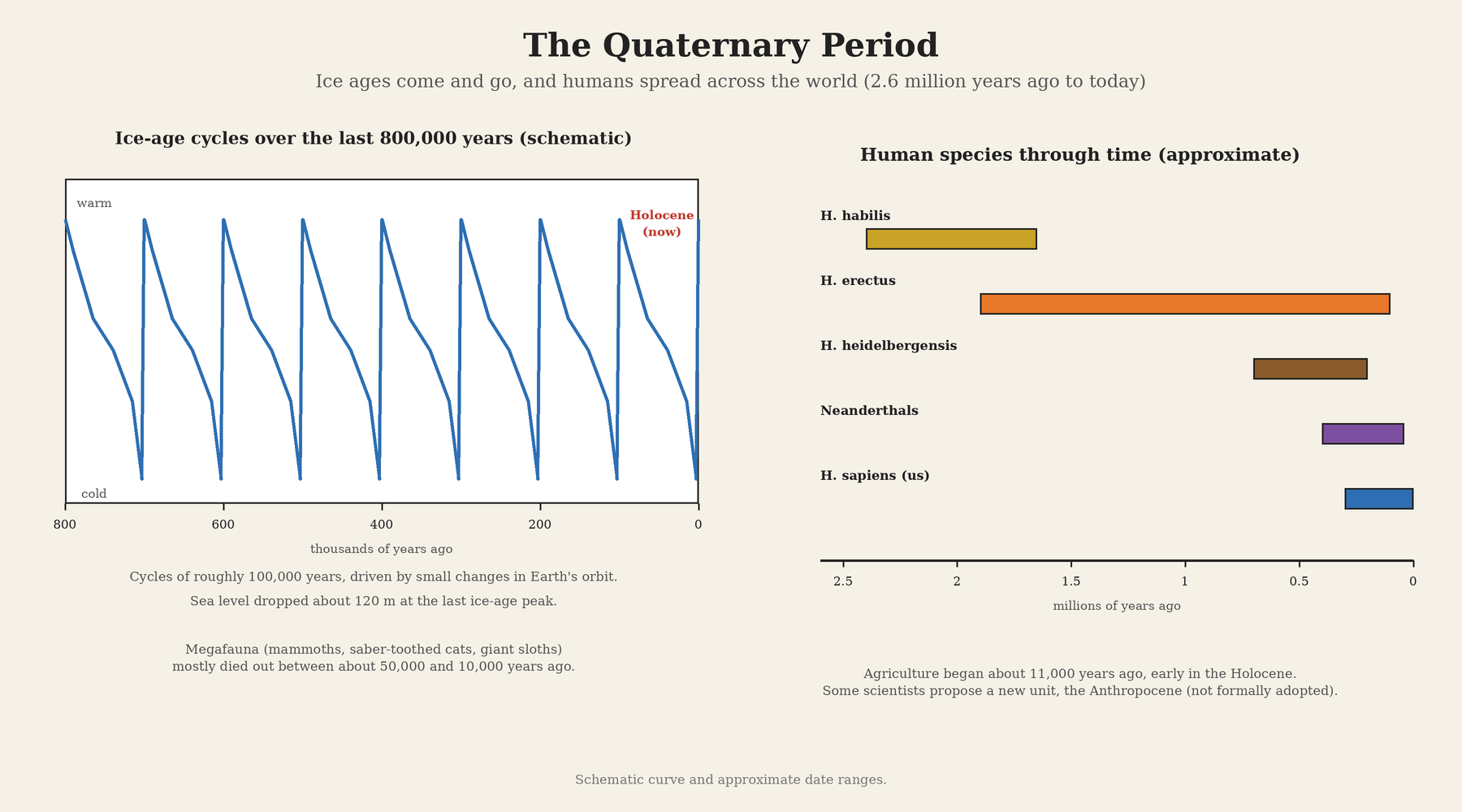
The Quaternary is the youngest and shortest period, and the one we are living in. It is marked by repeated cycles of ice ages, when vast ice sheets covered northern continents, alternating with warmer interglacial periods. Sea levels rose and fell by over a hundred meters as water was locked up in or released from the ice.
It is divided into two epochs: the Pleistocene (to about 11,700 years ago) and the Holocene (since then). Ice-age landscapes were home to woolly mammoths, saber-toothed cats, giant ground sloths and woolly rhinoceroses. Many of these large animals went extinct around the end of the last glaciation, as climate changed and humans spread.
The genus Homo arose early in this period. Our own species, Homo sapiens, appeared in Africa about 300,000 years ago and eventually spread across the whole planet. The warm, stable climate of the Holocene allowed agriculture, cities and civilization to develop.
Some scientists propose that human impact on Earth’s climate, species and geology is now so large that we have entered a new unit, the Anthropocene. It has not been formally adopted, but it reminds us that the story of geologic time is still being written.
The Ice Ages
The Quaternary is defined by climate cycles. Over the past 2.6 million years, ice sheets have grown and melted dozens of times. In the early Quaternary, cycles lasted about 41,000 years. Since about a million years ago, they’ve been longer and stronger, around 100,000 years.
The cycles are driven by small, regular changes in Earth’s orbit and the tilt of its axis, known as Milankovitch cycles, which alter how much sunlight reaches different latitudes in different seasons. These changes are amplified by feedbacks, such as ice reflecting sunlight and carbon dioxide dissolving in or escaping from the ocean.
At the peak of the last glacial period, about 20,000 years ago, ice sheets a few kilometers thick covered Canada, northern Europe and parts of Asia. So much water was locked in ice that the sea was about 120 meters lower than today. Land bridges connected Siberia and Alaska (Beringia), Britain and France, and New Guinea and Australia. These exposed lands allowed animals and people to spread.
Ice Age Animals
The ice ages produced a famous cast of large animals, often called the megafauna. Woolly mammoths, with long curved tusks and shaggy coats, roamed the cold steppes of Eurasia and North America. Woolly rhinoceroses, giant deer (Megaloceros), cave bears and steppe bison shared the same landscapes.
Predators included saber-toothed cats like Smilodon, whose long canines were used to kill large prey, and the American lion, dire wolves and cave hyenas. In the Americas, huge ground sloths (Megatherium, up to 4 tonnes), glyptodonts (armadillo relatives the size of small cars) and enormous short-faced bears wandered. Australia had giant kangaroos, Diprotodon and the marsupial lion.
The La Brea Tar Pits in Los Angeles are the best-known window into this world. Over tens of thousands of years, sticky asphalt trapped animals, and the pits have yielded thousands of saber-toothed cats, dire wolves, mammoths and more.
The Human Story
The genus Homo appeared in Africa around 2.5 to 2.8 million years ago. Homo habilis made simple stone tools. Homo erectus, from about 1.9 million years ago, was taller and had a larger brain, used fire, made more elaborate tools and spread out of Africa to Asia and Europe, the first human species to do so.
Other human species followed. Homo heidelbergensis in Africa and Europe was probably an ancestor of both Neanderthals and our own species. Neanderthals lived in Europe and western Asia from about 400,000 to 40,000 years ago, in cold conditions, with sophisticated tools, fire and probably symbolic behavior. Denisovans, known from a few fossils and DNA from Siberia, were another cousin. Tiny Homo floresiensis, the “hobbit,” lived on the Indonesian island of Flores until about 50,000 years ago.
Homo sapiens appeared in Africa roughly 300,000 years ago, with fossils from Jebel Irhoud in Morocco. Our species gradually spread out of Africa, mostly within the last 100,000 years, reaching Australia by at least 50,000 years ago (some evidence suggests 65,000) and the Americas by at least 15,000 years ago (some researchers argue for about 23,000). Along the way, we interbred with Neanderthals and Denisovans, and many living people carry a small percentage of their DNA. Eventually, we were the only human species left.
The Great Extinction of Megafauna
Between about 50,000 and 10,000 years ago, a large portion of the world’s biggest animals disappeared. Mammoths, mastodons, giant sloths, saber-toothed cats, glyptodonts, giant kangaroos and many others went extinct, hitting the Americas and Australia hardest. Africa lost fewer, perhaps because its animals had evolved alongside humans.
What caused this? There are two main hypotheses: climate change at the end of the last ice age, and hunting by humans. Most researchers think both played a part, and the balance varies by region. The timing of extinctions in Australia and the Americas often follows human arrival closely, which supports a strong human role.
The Holocene
The last ice age ended about 11,700 years ago, and the current warm interval, the Holocene, began. Ice sheets retreated, sea levels rose by over a hundred meters, and forests spread north. The climate has been unusually stable, with only small fluctuations.
This stability coincided with a transformation of human life. Agriculture arose independently in several places, including the Middle East, China, Mesoamerica and the Andes, beginning about 11,000 to 10,000 years ago. Settled villages grew into towns and cities. Writing, metal tools, states and trade followed. The whole span of recorded history, perhaps 5,000 years, lies within the Holocene, which itself is just a sliver of geological time.
The Anthropocene?
Humans are now a geological force. We move more sediment than rivers do, have altered the nitrogen and carbon cycles, driven many species extinct, spread plastic and concrete, and left radioactive isotopes from nuclear tests in rocks around the world. Atmospheric carbon dioxide has risen from about 280 parts per million before the Industrial Revolution to over 420 now.
Some scientists argue that these changes merit a new epoch, the Anthropocene, with a start date around 1950, when the “Great Acceleration” of population, energy use and industry began. In 2024, however, the International Union of Geological Sciences voted against formally adding it to the geological timescale. The term is still widely used informally, and debate continues about whether it should be an epoch, an event, or something else.
Whatever it is called, the Quaternary is a reminder that the story is not over. The same forces that shaped the Cambrian seas, the Carboniferous swamps and the Cretaceous skies are still at work, and now one species of mammal, a latecomer in a very old story, has a hand in writing the next chapter.