Hadean Eon (4.6-4.0 bya)
The Hadean is the first eon, named after Hades, the Greek underworld, because early Earth was hellish. It begins with the planet’s formation about 4.6 billion years ago, as dust and rock gathered into a world under constant bombardment from other bodies in the young solar system.
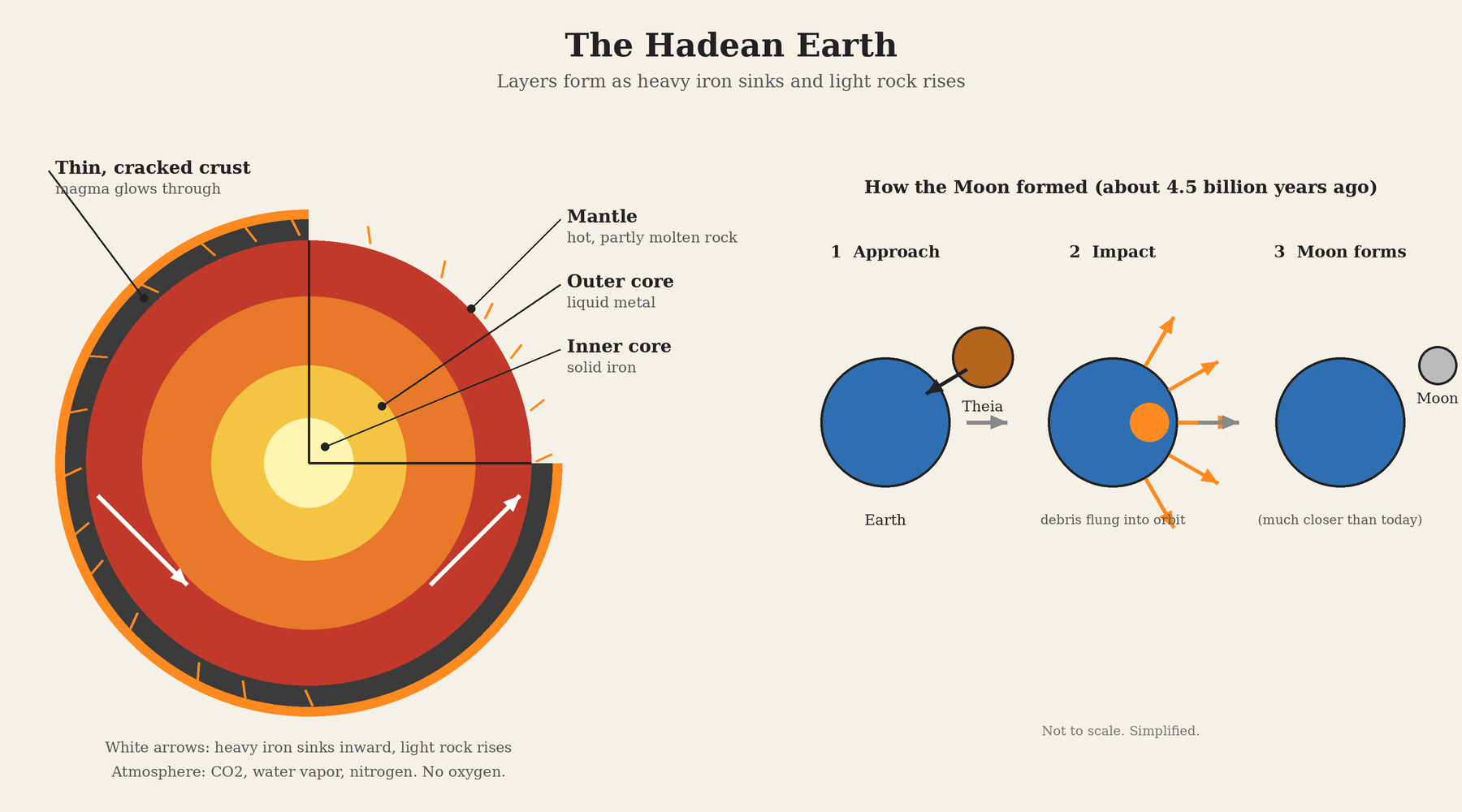
Early on, Earth was largely molten. Heat from collisions and radioactive decay kept the surface a sea of magma. Heavy iron sank to form the core, while lighter material rose to form the mantle and a thin crust. Around 4.5 billion years ago, a Mars-sized body, often called Theia, is thought to have struck Earth. The debris formed the Moon, which then orbited much closer than it does today.
As Earth cooled, a solid crust formed, and water vapor in the atmosphere condensed into oceans. Tiny zircon crystals from Australia, up to 4.4 billion years old, suggest liquid water and perhaps continental crust existed surprisingly early.
Almost no rocks survive from this eon, so our knowledge comes from zircons, meteorites and the Moon. There is no clear evidence of life, though the chemical ingredients for it were gathering. The Hadean is not divided into eras or periods.
Building a Planet
The solar system began as a vast, slowly rotating cloud of gas and dust. A nearby event, perhaps a supernova, may have nudged it into collapse. Most of the material fell into the center and ignited to become the Sun. The rest flattened into a spinning disk, and within it, dust grains stuck together, then clumped into pebbles, boulders and ultimately planetesimals, bodies kilometers across.
Through repeated collisions, these planetesimals merged into a handful of rocky worlds. This process of accretion, which took only tens of millions of years, built the young Earth. Each impact delivered tremendous energy, and together they heated the planet until it melted from the surface to a great depth. The famous “magma ocean” was real: a sea of molten rock hundreds of kilometers deep.
Meteorites that fall to Earth today, particularly those called chondrites, are leftovers of this building material. Dating them gives the age of the solar system, about 4.567 billion years, which is why we use that number for the origin of Earth.
Layers of Fire: The Birth of Core and Crust
In a molten planet, heavy things sink and light things float. Iron and nickel, being dense, migrated toward the center and formed the metallic core. Lighter silicate minerals rose and became the mantle above it. This separation, called differentiation, released further heat and was probably complete within the first hundred million years.
The consequences are still with us. The liquid outer core, churning around a solid inner core, generates Earth’s magnetic field. That field acts as a shield, deflecting the charged particles of the solar wind that would otherwise strip away the atmosphere. Without it, Earth might have ended up as barren as Mars.
At the surface, the first crust formed as the magma ocean cooled, but it was repeatedly broken, remelted and recycled by impacts and volcanism. A stable, lasting crust took time to appear.
The Moon-Forming Impact
The most dramatic event of the Hadean was the collision that made the Moon. According to the leading hypothesis, a Mars-sized planet, nicknamed Theia, struck the young Earth a glancing blow roughly 4.5 billion years ago. The impact vaporized part of both bodies and flung a ring of debris into orbit. That debris soon gathered into the Moon.
Evidence supports the idea. Moon rocks brought back by the Apollo missions are chemically similar to Earth’s mantle, and the Moon has a small iron core, just what you would expect if it formed from outer, rocky layers rather than from the centers of the colliding planets. Some scientists now think that mixing during the collision was even more thorough than first thought.
The young Moon orbited much closer than it does now, perhaps only twenty thousand kilometers away, and would have appeared enormous in the sky. Tides on Earth, raised in the magma and later in the oceans, would have been immense. Over billions of years, the Moon has spiraled outward, and it still drifts away at about four centimeters a year. Days on early Earth were also far shorter, perhaps five or six hours long.
Water and Air
Where did Earth’s oceans come from? Scientists still debate it. Some water was probably locked into the rocks that built the planet and released by volcanoes as steam. Some may have been delivered by icy comets and water-rich asteroids from the outer solar system. Measurements of hydrogen isotopes in seawater match certain types of asteroids closely, suggesting that they were a major source.
The earliest atmosphere was not the one we breathe. It was a dense blanket of carbon dioxide, water vapor and nitrogen, with traces of other gases, and no free oxygen at all. As the planet cooled below the boiling point of water, the steam condensed and rain fell for what must have been an immense span of time, filling the basins and creating the first oceans.
Evidence for this early water comes from the zircon crystals of the Jack Hills in Western Australia. The oldest, dated to 4.4 billion years, carry a chemical signature suggesting they formed from rock that had interacted with liquid water. If so, Earth had oceans, and possibly some continental crust, within 150 million years of forming, far earlier than once believed.
The Late Heavy Bombardment
For a long time, scientists thought that around 4.1 to 3.8 billion years ago, a spike of asteroid and comet impacts battered the inner solar system, an episode named the Late Heavy Bombardment. Lunar craters and the ages of Moon rocks seemed to support it. The idea was that the migration of giant planets such as Jupiter and Saturn may have destabilized the asteroid belt and sent a barrage inward.
More recent work has questioned whether there was a sudden spike at all, or just a long declining tail of impacts from the planet-building era. The debate continues. What is certain is that the early Earth was struck often and hard. Large impacts could have boiled away the oceans and sterilized the surface, perhaps repeatedly, which makes the timing of life’s origin all the more puzzling.
Was There Life?
The Hadean is named for hell, but it may not have been entirely hostile. Between impacts, Earth may have had stretches of relative calm, with warm oceans, volcanic islands and hot springs. Many researchers think the chemistry leading to life could have begun in such places, in hydrothermal vents, shallow pools or on mineral surfaces.
There is tantalizing but disputed evidence. Some tiny grains of carbon found trapped inside a Hadean zircon have a ratio of carbon isotopes that looks like what living things leave behind. It is intriguing, but one grain is not enough to settle the matter, and chemistry can sometimes mimic biology.
The Hadean ends by convention at 4.0 billion years ago. After that, the rock record begins in earnest. We are left with an eon known mostly through crystals, meteorites and the cratered face of the Moon, which acts as a kind of fossil record of what the early Earth endured.