
The Dark Ground
The Body Knows Darkness
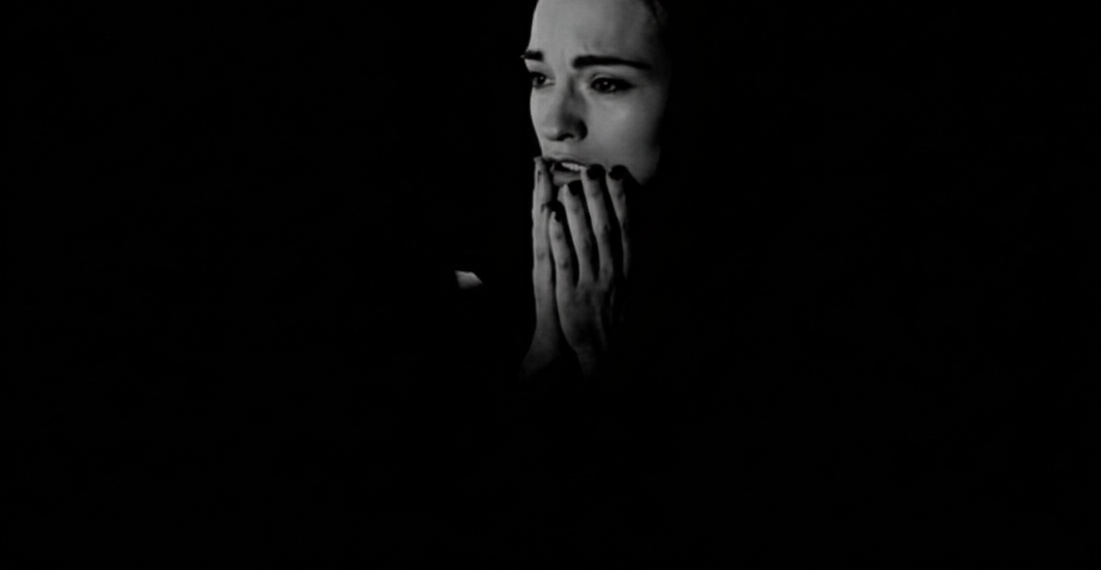
Elina Löwensohn — Nadja (1994)
You cannot project darkness. You can aim a light source at a face, and the darkness will be what remains where the light does not reach. That asymmetry is not compositional preference — it is physics. Darkness does not travel. It does not arrive. It is already there, the ground condition of the frame and of the universe, and light is what darkness occasionally does.
This is why chiaroscuro works, and why it works in a direction that cannot be reversed. A face lit against deep shadow is not the same event as a dark silhouette against a white field, even though both are technically light against dark. The white-dominant image is inert. Light everywhere is light settled, light finished — no emergence, no event, nothing requiring attention. But light arriving from darkness triggers something older than aesthetics, older than thought.
Twenty thousand years ago, an animal emerging from darkness was not a contrast study. It was a threat, a possible danger arriving from the prior condition of the world. The body responded — not because it had decided darkness was meaningful, but because darkness was the ground condition and something had moved within it. The nervous system did not learn this. It was built around it. We carry that wiring intact. It fires before we have time to have an opinion about it.
Michael Almereyda's 1994 film Nadja — a vampire story shot in black and white — is not an obvious place to find philosophy made visible. But cinematographer Jim Denault's lighting of actress Elina Löwensohn does exactly that. The darkness in those frames is not merely atmosphere or gothic decoration. It is the dominant condition of the image, the majority of what is there, and Löwensohn's face emerges from it partially, incompletely — the way consciousness itself emerged from a universe that was not waiting for it, the way anything emerges. Temporarily. Without guarantee of continuation.
The image does not argue for this. It shows it. And the body, carrying its twenty-thousand-year-old knowledge of what it means for something to arrive from the dark, responds before the mind has formed a single thought about art or philosophy or the nature of light.